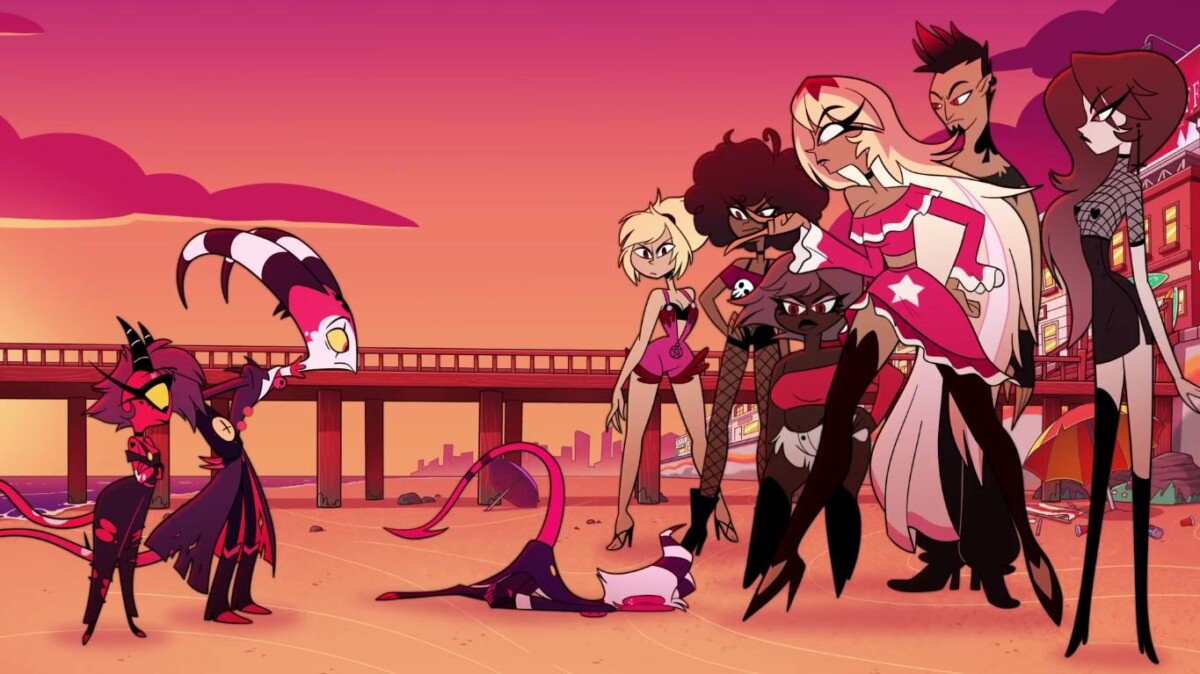
(Image courtesy of IMDb. “’Helluva Boss’ disappoints following a successful round of broadcast.”)
Adelaide Gotti
Connector Staff
There was a time when Vivienne Medrano’s (Vivziepop) indie creation felt like a breath of fresh air in adult animation. With its dark humor, nice soundtrack, and sharp focus on the emotional and professional struggles of the I.M.P. crew, “Helluva Boss” won over millions of viewers. Now, midway through Season 3 (with episodes coming out every week during October 2026) that early excitement is giving way to a widespread and undeniable sense of fatigue. The show’s quality continues to slip, and the prevailing feeling online is that it is losing its soul in pursuit of its own fandom’s more toxic dynamics.
One of the most heated points across social media is the series’ increasingly heavy overlap with its sibling universe, “Hazbin Hotel”. What once felt like pleasant, occasional winks at the broader Hellaverse now comes across as a calculated, artificial marketing strategy. The new cross-references create the impression that the writing is driven less by narrative necessity and more by a desire to fuel fan theories and speculation.
The deeper fracture with the community, however, centers on character handling and nowhere is this clearer than with Stolas. The Goetia prince has undergone arc that recalls the public trajectories of certain pop-culture figures: adored and idealized across the first two seasons, he has now become a lightning rod and a source of frustration for the audience. The writing continues to frame him primarily as a tragic victim, rarely forcing him to confront the real consequences of his actions or privileges. His recent emotionally immature choices and his treatment of Blitzo and his own life have turned former sympathy into exasperation, reinforcing the sense that the creators no longer know how to develop his arc without falling into repetition or soap-opera territory.
Into this mix arrives Vassago. On one hand, the new Goetia demon provides a useful narrative device, offering alternatives to Stolas’s emotional stagnation and advancing the Ars Goetia storyline. On the other hand, the dominant online consensus is that Vassago was conceived as pure, unapologetic fan service. With a design clearly engineered to appease the shipping and fanart corners of the internet, the character often feels more like a visual marketing product than an organic part of the world. His presence, while functional in certain scenes, only highlights the season’s structural weakness: the reliance on flashy surface elements to paper over a dramaturgy that has grown sticky and uncertain.
The verdict on this stretch of Season 3 episodes is therefore a bitter one. The animation and visual craft remain undeniably high caliber, yet they cannot compensate for the missing spark of dramatic and comedic brilliance that defined the show’s earlier chapters. The internet is unforgiving, and the community’s judgment seems clear: “Helluva Boss” needs to regain its compass, stop leaning on the clichés its own audience helped create, and return to telling an authentic story, before the decline becomes irreversible. The Internet can only hope that the final two remaining episode will manage to turn things around, allowing the fans to look ahead to the second half of Season 3 with greater hope. Right now, the outlook appears decidedly bleak.
Grade: C
