







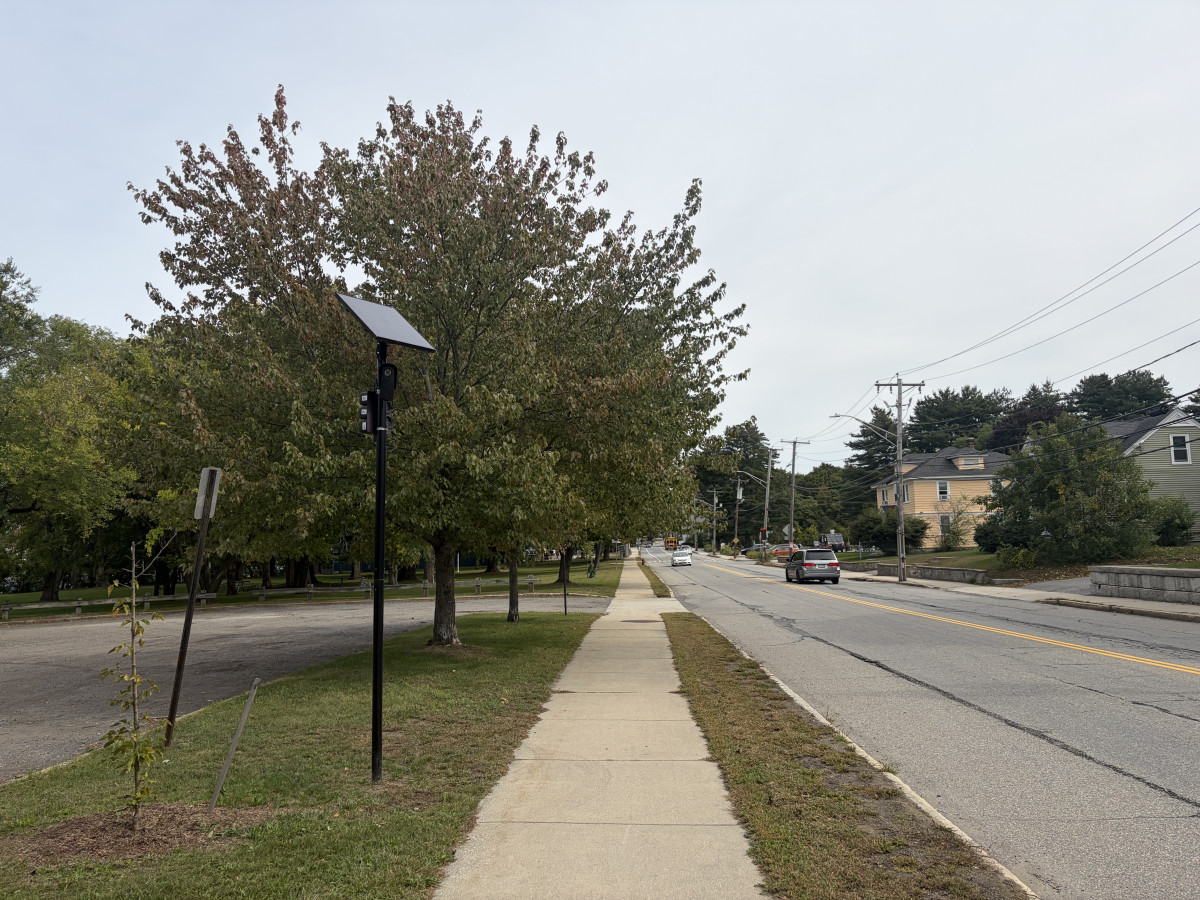
(Photo courtesy of Makayla Mahoney) Flock Safety automated license plate reader on Pawtucket St. in Lowell, MA, on Friday, Sept. 25, 2026.
Makayla Mahoney
Connector Editor
Security, privacy, protection, and surveillance: Flock cameras have been the cause for debate among several communities across the United States as cameras begin to pop up around towns and cities. Lowell is one of these cities now facing the ongoing discourse surrounding the installation of these cameras and whether the benefits of supporting law enforcement in deterring crime or the costs of violating people’s right to privacy outweigh the other.
Lowell’s city council made a motion on this issue on Tuesday, Sept. 22, led by Councilors Scott and Nuon who sought suspension of the use of Flock equipment while the city evaluates its continued use. This motion passed 6-5, with councilors planning to reconvene in two weeks after further investigation.
Flock cameras, or automated license plate readers (ALPRs), focus on and identify vehicles, logging their license plate, make, model, color, and other characteristics, as described on the Flock Safety website. This information is stored in a database that can be shared with other police departments in order to “respond to emergencies and investigate safety incidents,” as the website further details. The Lowell Police Department, for example, shares their ALPR data with New England municipalities, as well as the state of New York.
There are currently 36 Flock automated license plate readers in Lowell, seven of which are within or surrounding UMass Lowell according to Deflock the USA. As of Tuesday, Sept. 22, the use of these cameras has been suspended while the city investigates the audit process and standing policy to protect against abuse.
Several residents of Lowell spoke at Tuesday’s city council meeting, either in support of or in opposition to the use of Flock cameras in the city. Among the concerns shared were the incidents of Flock misuse in other Massachusetts towns, such as Stow, New Bedford, and Lynn, where police officers were accused of using the database for personal searches. The city of Boston has also ended its contract with Flock due to the company’s sharing of vehicle data outside of the Boston police department, despite an agreement that secured the data within the city.
These concerns were additionally shared by members of Lowell’s city council, who acknowledged these cases of misuse and the need for greater oversight of this technology. Councilor Vesna Nuon, a co-creator of the motion to suspend Flock camera use for the meantime, questioned “how do we balance public safety with community expectations for privacy and accountability?” Among the council was a shared caution of the new technology and an understanding of the Lowell police department’s preferred use of these ALPRs, claiming cost and time efficiency in investigating crimes within the city.
As these cameras face suspension for the next two weeks, Flock Safety’s integrity and responsibility in protecting the data is one factor to be investigated. Mayor Gitschier warned during Tuesday’s meeting, “It’s been documented that this company gives you a lowball price so that they can share your information”. This sentiment was shared by Councilor McDonough who stated, “the thing you’re using is not the product, your data is the product”.
Political Science Professor and Director of Survey Research at UMass Lowell’s Center for Public Opinion, John Cluverius, shared his insight on the issue from the perspective of public opinion. He stated, “I think you’ll see more and more citizens calling for suspension, repeal, and removal of these products because the feelings of everyday citizens about artificial intelligence technology are decreasing and that has to do with data centers and that has to do with cameras”.
In a poll taken by the Center for Public Opinion on Thursday, Sept. 24, residents of Maine were asked about their support for Flock cameras, with 58% of respondents supporting a ban on ALPRs in their community and 42% opposing a ban.
Professor Cluverius further noted, “The level of distrust that people have in government overall, in law enforcement somewhat, and in artificial intelligence technology a lot, create an environment that’s really unfriendly for automated license plate reader technology.”
As you drive through Lowell within the following weeks, you may spot these tall black polls, topped with a panel and camera pointed toward major streets such as Pawtucket St., Middlesex St., and Merrimack St. For the time being, these ALPR cameras are off as the city decides whether Flock will support public safety in Lowell or undermine resident’s right to privacy.
