








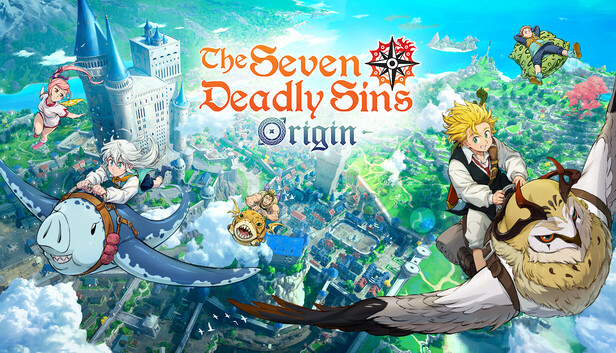
(Image courtesy of Steam. “‘The Seven Deadly Sins: Origin’ takes players on an intriguing adventure.”)
Maxi France
Connector Editor
The Japanese role-playing adventure game “The Seven Deadly Sins: Origin” released for mobile audiences on March 23, 2026. Originally a manga series and developed by Netmarble, the game features Japanese voice acting with English subtitles and is objective-based, relying on character movement and fighting enemies to progress to checkpoints.
The story follows the young Tristan, prince of the Kingdom of Liones, and his friend Tioreh as they encounter various enemies originating from a time warp that they will need to defeat before proceeding along their journey to restore order to their world. They also encounter characters like an endearing talking pig named Hawk which Tristan uses as transportation and a knight named Howzer, who seeks to protect the Kingdom of Liones.
The gameplay involves playing through cinematic cutscenes with dialogue between the characters, which the player can skip. In between them are opportunities for Tristan or Tioreh to explore a given environment before proceeding to a checkpoint, like a cave or a field. During this explorable environment, a marker may direct the player to a given location to start the next cutscene. There is a crafting element of the game, where it is possible to cut down trees to collect wood materials to craft healing potions. However, the player can also encounter monsters when exploring, ranging from bears and bison to a giant robot. Sometimes they will follow the player. After encountering these enemies, the game directs the player to a combat sequence.
In this gameplay mode, the player can alternate between Tristan and the rest of his team—the characters that accompany him—to combat the enemy. Each character has different types of attacks of various effects, but there are cooldowns for each of them, meaning that the player must wait for several seconds after using a power to activate it again. In this mode, each enemy has a bar attached to them that indicates how close they are to being eliminated. Each combat sequence will last a certain amount of time depending on the strength of the enemy.
A key positive of the gameplay is how easy it is to beat the enemies in combat mode. It is simple for the player to run from the enemy in combat mode to defend themselves while simultaneously wounding the enemy. In addition, when proceeding from location to location, the game gives a specific indication of how far away the player is from the next checkpoint, allowing them to navigate the area more easily.
However, at the beginning, there are also several key places where the game can fail to capture an audience. For example, when first downloading the game on a phone, the player may find that it is slow to start up and would perhaps be better off taking a snack break or reading a book while waiting for the screen to load.
In addition, while the game is appropriately tailored for different platforms like PlayStation and PC, its directions for the mobile version can be more clear. For instance, when the game instructs the player to aim a locus stone, it doesn’t specify in words where exactly the player should aim it. Instead, the game just shows a glowing box by the door to indicate the location. Players new to the genre might not know how to pay attention to that subtle visual clue. The lack of explicit direction can make progression feel accidental, contributing to a lack of player satisfaction.
On the plus side, the music and graphics are shining stars of the game. In the background of the loading screen and in some combat scenes, a powerful orchestra can be heard. For the art and design, on the starting screen, there are nice additions like people moving around and birds flying. Those details bring life to the game. In the cutscenes, the characters subtly move and blink when they’re talking, adding realism to an otherwise fantastical setting.
Overall, “The Seven Deadly Sins: Origin” has some redeeming qualities in its visuals and combat system but is hindered by its initial slowness on the mobile version and lack of full accessibility for players. Fans of traditional RPGs can have something to look forward to if they can look past these issues.
Grade: B-