




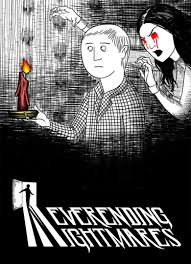
(Image courtesy of IMDb. “‘Neverending Nightmares’ draws players in with psychological horror.”)
Adelaide Gotti
Connector Contributor
There is a fine line between using video games as a form of entertainment and transforming them into an intimate, cathartic art form. “Neverending Nightmares”, a psychological horror game created by Matt Gilgenbach and published by Infinitap Games, successfully bridges this gap. Moving beyond the conventions of traditional horror, it offers a disturbing exploration of the darker corners of the human mind, drawing on experiences rooted in real-life suffering.
Following the financial and personal difficulties surrounding Gilgenbach’s previous projects, “Neverending Nightmares” emerged as an intensely personal attempt to process depression, anxiety and the intrusive thoughts associated with his own experience of obsessive-compulsive disorder (OCD). What might otherwise have remained a straightforward expression of personal anguish becomes a remarkably candid and unsettling work within the indie horror gaming scene.
The game’s greatest strength lies in the way its narrative and mechanics work together to convey the feeling of being trapped that can accompany depression and OCD. The protagonist, Thomas, repeatedly awakens within one nightmare after another, caught in a claustrophobic cycle in which the boundary between reality and illusion gradually dissolves. Whenever Thomas dies or wakes in terror, his surroundings change in subtle but increasingly disturbing ways. Familiar spaces become darker, more distorted and more threatening.
This repetition is more than a narrative device. It evokes the exhausting persistence of unwanted thoughts and the feeling of being unable to escape one’s own mind. Rather than simply telling players about psychological distress, the game invites them to experience a version of that helplessness through its structure, turning repetition itself into a source of dread.
Thomas is, indeed, a common person. Confused, scared, not happy to wander inside this nightmare, forcing himself to wake up when too scared… he is even asthmatic, making his running inefficient and even dangerous in the long run. The player will have to choose thoughtfully when to let Thomas run, knowing that not much longer the character will stop in his track to breathe, just like any other common person and not the superhumans commonly represented in movies.
The visual design is equally essential to the experience. Rendered in stark black and white, with a style reminiscent of Edward Gorey’s illustrations, the game presents a world that is stripped down, precise and deeply unsettling. Color is used sparingly, drawing attention to specific interactive elements and, most notably, vivid red imagery associated with blood and self-harm. The disturbing images scattered throughout Thomas’s journey are not merely there for shock value. They contribute to the game’s representation of intrusive, violent thoughts and the distress they can cause.
The imagery can be difficult to watch, but its purpose extends beyond conventional gore. By translating internal fears into tangible visual threats, the game creates an intimate connection between its protagonist’s psychological state and the world surrounding him. Its artistic restraint makes these moments particularly effective: the monochromatic environments leave little room for distraction, allowing each burst of color to carry a greater emotional impact.
In terms of gameplay, “Neverending Nightmares” deliberately embraces simplicity. Players have limited controls, move slowly and must occasionally hide from or escape the monstrous figures inhabiting Thomas’s nightmares. By minimizing mechanical complexity, the game directs attention toward its visual storytelling and psychological atmosphere. Some players may find the slow movement and repetitive exploration frustrating, but these qualities also reinforce its central themes. Progress feels laborious, familiar spaces become sources of dread, and escape never seems guaranteed. The mechanics thus contribute to the emotional experience rather than serving merely as a means of progression.
The game’s multiple endings, shaped by the paths players take and the choices they make, reflect the uncertainty and complexity of its narrative. Rather than offering a straightforward resolution or an easy message of hope, “Neverending Nightmares” leaves room for interpretation. Its conclusion encourages reflection on suffering, vulnerability and the difficulty of finding a way forward when one’s own thoughts become a source of fear.
Ultimately, “Neverending Nightmares” is a striking example of personal experience informing artistic expression. Gilgenbach transforms professional disappointment and his struggles with mental illness into a distinctive work of interactive horror. The result is not always comfortable to experience, nor is its deliberately repetitive gameplay likely to appeal to everyone. However, its artistic vision and willingness to explore deeply personal subject matter set it apart from horror games that rely primarily on sudden scares.
Grade: A