




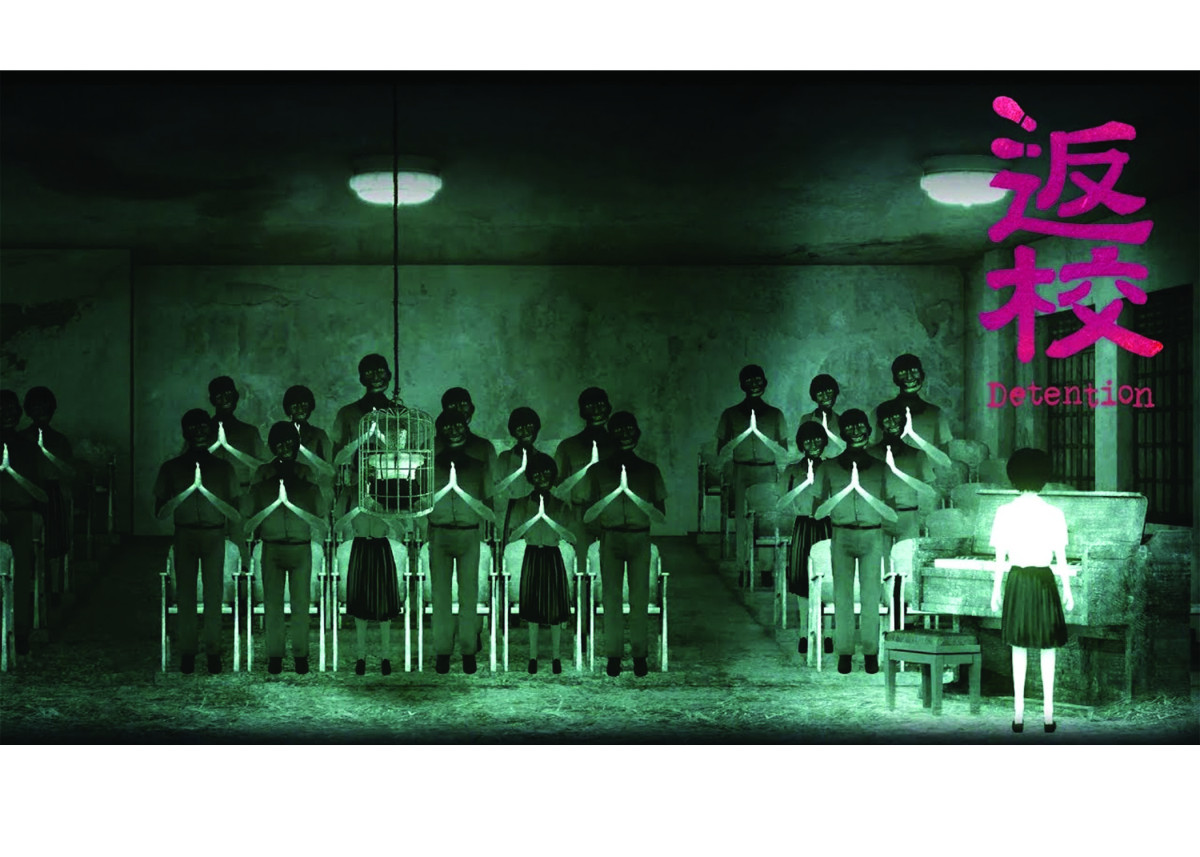
(Image courtesy of IMDB. “Detention shines a light on the realities of martial law.”)
Adelaide Gotti
Connector Contributor
Released in 2017 by the Taiwanese independent studio Red Candle Games, “Detention” remains one of the most compelling intersections of psychological horror and political history in modern video games. In the years following its release, Red Candle Games acquired a somewhat tragic notoriety. Their subsequent project, “Devotion” (2019), was pulled from digital storefronts after players discovered an easter egg poking fun at Chinese President Jinping by referencing Winnie the Pooh. There is a deep, poetic irony in the fact that Red Candle Games became the target of modern state censorship just two years after releasing a masterpiece explicitly dedicated to the themes of censorship, political dictatorship and the suppression of free thought.
Set in 1960s Taiwan, “Detention” immerses players in the dark reality of the White Terror—a brutal period of martial law characterized by violent anti-communist paranoia, strict state censorship and the rejection of both left-wing ideology and Western capitalism. The game subtly demonstrates how authoritarian violence does not always require physical weapons to inflict catastrophic harm; systemic fear and betrayal can be just as deadly. Note: Major spoilers and difficult themes ahead.
The narrative opens with a scenario familiar to many students. A high school boy named Wei falls asleep at his desk during a lesson taught by his teacher, Miss Yin. Before he drifts off, the intimidating Instructor Bai, a military officer stationed at the school, knocks on the door to inquire about a suspicious list of books. When Wei awakens, the classroom is deserted and a typhoon warning is scrawled across the chalkboard. Attempting to escape, Wei ventures to the auditorium, where he meets Ray, a fellow student who also fell asleep. Their escape is promptly blocked by a raging river of blood, leaving them trapped within the school.
From this point, control shifts entirely to Ray. Soon after, Wei is found murdered, hung upside down—a torture method historically used in Taiwanese detention camps. As Ray navigates the corridors of the school to find a way out, the tragic timeline of her life begins to unravel.
Ray’s story is one of profound isolation. Coming from a broken home where her father cheated on her mother, Ray witnessed her mother retaliate by reporting her husband to the state authorities. Ray starts seeing the school counselor, Mr. Chang, eventually entering a secret romantic relationship with him. Simultaneously, Miss Yin and a small group of students, including Wei, form an underground book club to read literature banned by the regime. Recognizing the inappropriate nature of Mr. Chang’s involvement with Ray, Miss Yin confronts him, urging him to end the affair and asking “Did you forget about us?”, referring to the book club.
Overhearing this conversation and feeling discarded, suspecting a relationship between the two, Ray resorts to the toxic mechanism she learned at home and so she steals the book club’s reading list and hands it over to Instructor Bai. The consequences are devastating. The club members are arrested and sent to labor camps and Ray is consumed by unbearable guilt, ultimately taking her own life.
The game’s central twist is brilliantly foreshadowed through environment and mechanics. The river of blood obstructing the exit recalls traditional East Asian mythology regarding the boundary to the underworld. The mysterious old woman who offers guidance resembles Meng Po, the deity responsible for forgotten memories. Ray is trapped in a loop, forced to relive her sins until she truly confronts her own accountability.
Mechanically and aesthetically, “Detention” excels through restraint. The developers champion a minimalist user interface, allowing the oppressive soundscapes and melancholic art style to build tension through anticipation rather than cheap visual thrills. While it can be a bit cheap with its jump scares at times, the core horror stems from the tragedy of human fragility under totalitarian pressure. The puzzles strike a comfortable balance (no “Silent Hill” Shakespeare!) allowing the narrative momentum to remain uninterrupted.
Ultimately, “Detention” is not merely satire; it is a sobering historical reflection. It highlights how, under extreme political repression, even the most private human emotions—love, jealousy, and rejection—can be weaponized into instruments of destruction. The title itself has multiple interpretations, representing a school punishment for students, the literal imprisonment of dissidents and the eternal spiritual confinement of a soul unable to forgive itself.
Grade: A