







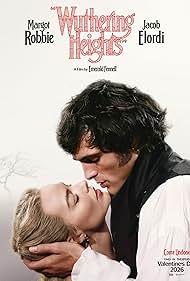
(Image courtesy of IMDB. “‘Wuthering Heights’ is fanfiction at best and gross misunderstanding of classic literature at worst.”)
Emily Lindtveit
Connector Contributor
On February 13th, director Emerald Fennel released “Wuthering Heights”, her adaptation of Emily Brontë’s 1847 novel Wuthering Heights, and with-it giving English literature enthusiasts everywhere migraines. Marketed as the “greatest love story of all time”, Fennel’s adaptation misses one key element of the book; Wuthering Heights is not a love story. It has elements of romance, but the story is not an Austen-esq romance with the smart witty heroine with her brooding hero strolling across the field towards her at dawn. Wuthering Heights would be better described as gothic fiction. It’s a story that deals with themes of racism, classism and generational trauma, and the romances in the story are conduits to explain Brontë’s opinions.
Starting this off with the big racist elephant in the room, Heathcliff not being a person of color severely takes away from the story, however after seeing the film, it’s clear Emerald Fennel did not want to tell the story of Wuthering Heights. She wanted to tell an erotic, forbidden, taboo romance set in vaguely Victorian times. She didn’t need the name Wuthering Heights to do that; she’s a very successful director in her own right. Instead of creating a different, interesting, and thought-provoking original piece of art, she used, and arguably abused, a good portion of the characters to tell the story she wanted to.
Jacob Elordi and Margot Robbie’s casting has been debated since it was announced, but they deliver decent performances. The worst scenes are when they are playing 16-year-old children. They both look way older than they are playing, and it comes off as disingenuous, and you question their actions until you remember they’re supposed to be playing teenagers. Once they have the 5-year time skip, their dynamic works a little better, and their overall look works better.
Every character has something changed from the novel, with some changes being more egregious than others. Fennel combines characters, changing motivations, and removing abusive situations. Her decision to not adapt the second half of the novel gives a lot less for her to work with to keep a coherent story, so some changes could be forgiven if executed properly.
One character who is done especially dirty by Fennel’s creative interpretation is Isabella. In the novel, Isabella is Edgar Linton’s sister and marries Heathcliff out of naivety to his true monstrous nature. Almost immediately, she leaves him and proceeds to live alone with her child for 12 years. She has agency and leaves an abusive situation, something that can be hard for people to do today. She writes in the novel a letter to Nelly, the narrator, about how she was taken advantage of and that she was swept away by someone who presented himself as charming and trustworthy. The movie reduces her to someone who enjoys being abused, almost desiring that kind of dynamic. She cries and screams when she’s forced to leave, and even though Heathcliff is very clear with his intentions to only use her for revenge, she thinks she can fix him. Isabella is the worst of the character changes, but it illustrates the best how some of the changes in this movie removed the lessons the book was supposedly to teach.
The question then remains, did the movie have any good aspects? The answer is actually yes. The two actors who played the children’s versions of Cathy and Heathcliff (Catherine Melington and Owen Cooper) were good. Even with my issues regarding Jacob Elordi’s casting, they couldn’t have done better casting his younger self. The two actors were more in line with their book counterparts than Elordi and Robbie, and their ending scenes were the most moving of the whole film. There are scenes towards the end that weren’t described in the book. Around the time Catherine is sick, she hallucinates young Heathcliff and has a moment right before she passes with Nelly. Both of those scenes were probably the most emotional I felt during the movie and were really good additions. They were in line with the novel while showing Fennel’s prowess in directing. The cinematography was really gorgeous; I thought a lot of the shots were directed very well. The costumes were outlandish and not super historically accurate, but they fit the aesthetic of what the movie was going for. The costuming of Catherine (Robbie) is easily the best part of the whole movie.
Adaptations always bring up an interesting question of how far a director can go with changes before it doesn’t become the same story. Most of these criticisms for the movie are not for the movie itself; it’s for its ties in the book. If this film had a different title and different character names, I don’t think it would receive a good portion of the backlash it currently is getting, and I myself actually would have enjoyed the movie. I am all for creating art and receiving inspiration from classics. However, when you make an adaptation of a piece of art that already exists, you will have to remember that there will be source material to compare it to, and you cannot be frustrated when people begin to bring up said source material. With this adaptation, Emerald Fennel created one big ship of Theseus metaphor; if I strip the characters of what drives them and force them to fit my interpretation, am I still telling the same story?