












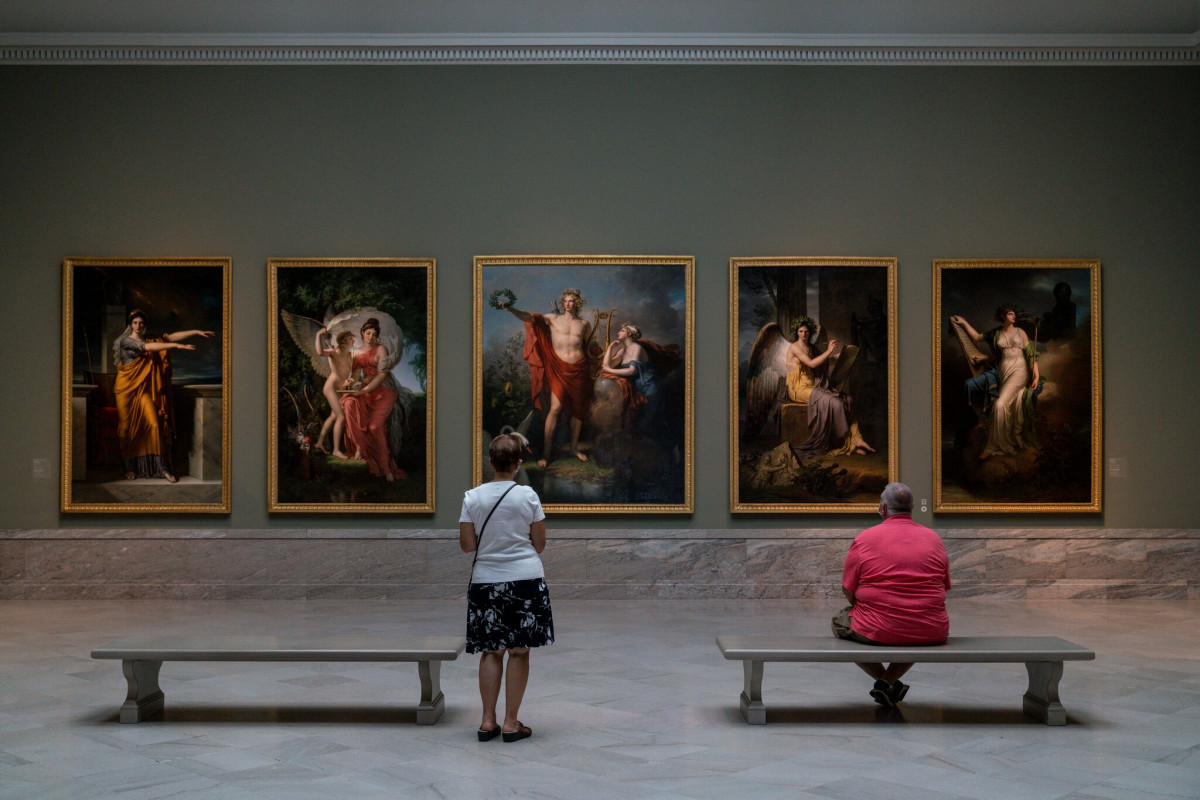
(Photo courtesy of Sarah Rice from The New York Times) “Charles Meynier’s painting cycle ‘Apollo and the Muses,’ 1798-1800, in the neoclassical gallery at the Cleveland Museum of Art
Jesse Nguyen and Olivia O’Sullivan
Connector Editor and Connector Staff
Have you ever felt guilty about having a hobby? Or do you ever get that weird feeling when someone sees your creative work and their first response is “Oh nice! Have you been selling any of this?”
Well, what you might be feeling is the depressing effects of capitalism. In America, capitalism leads to efficiency and innovation, but it also diminishes creativity and wonder, and undermines the passion you may feel if what you love doesn’t produce tangible results. Capitalism transforms art into a commodity. Whatever value art has is reduced to its monetary value rather than any actual meaning it has. This leads to art being seen as a luxury for the wealthy, even though artists themselves still struggle to earn a livable wage.
When it comes to making art, it’s a significant time investment. Nobody is born so talented that they immediately know how to create art; it’s a skill that has to be honed for many years. “Hustle culture” has created an environment in which you must always be working towards the next accomplishment, where one success is merely a steppingstone for the next, and where we are shamed for having passions that fulfill us.
This unending race for tangible success can be seen in every aspect of our culture, even with changes to how business operates and the architecture that surrounds us. A lot of coffee shops nowadays have policies where you aren’t able to sit and socialize for long, even if you paid for a meal. This speaks to how building relationships, human meaningful connections, and human principles like empathy are also cast aside to prioritize financial gain. Sacrificing your wellbeing for financial success is a reality that disproportionately benefits the system rather than you as an individual.
In education, for example, STEM degrees are much more valued than art and humanities degrees. It’s quite simple as to why, really, as art is priceless in its understanding of what it means to be human. Because it’s so intangible, a price tag cannot be attached to it, deeming it practically worthless in a money-driven society. Meanwhile, an engineer can easily craft a missile, or a biologist can manufacture a cure that can be sold to hospitals. The STEM side leads to tangible results, and art’s main purpose, which is to synthesize the human experience into visual and auditory works, is often seen as an unproductive contribution to our society.
I recently saw a Tik Tok video of @dadmodeindarkmode, a 40-year-old man, expressing how he’s felt like he’s wasted his life. He goes on to talk about how he’s got nothing to show for it, no house, no savings, no career he’s proud of. He ushers his viewers, especially if they’re in their early 20s or 30s; they have no time. He recalls his experiences in his 20s, where he had tattoos and played drums, but felt like he wasn’t “building anything real.” This is incredibly sad to me because what he describes sounds like a fun life. But because it didn’t lead to economic growth, what capitalism promotes, he feels like his value is tied to his productivity and not his personhood.
This is not just an unfortunate consequence of capitalism, but an intentional building of its structure to promote tangible economic gain over the enrichment of human experience. This is not to dismiss STEM and praise the arts – in reality, humanity needs both to survive, innovate, and flourish. The problem presents itself with how our current society skews the value of the two concepts so greatly.
To quote John Keating from the Dead Poet’s society, “And medicine, law, business, engineering, these are noble pursuits and necessary to sustain life. But poetry, beauty, romance, and love are what we stay alive for.”