












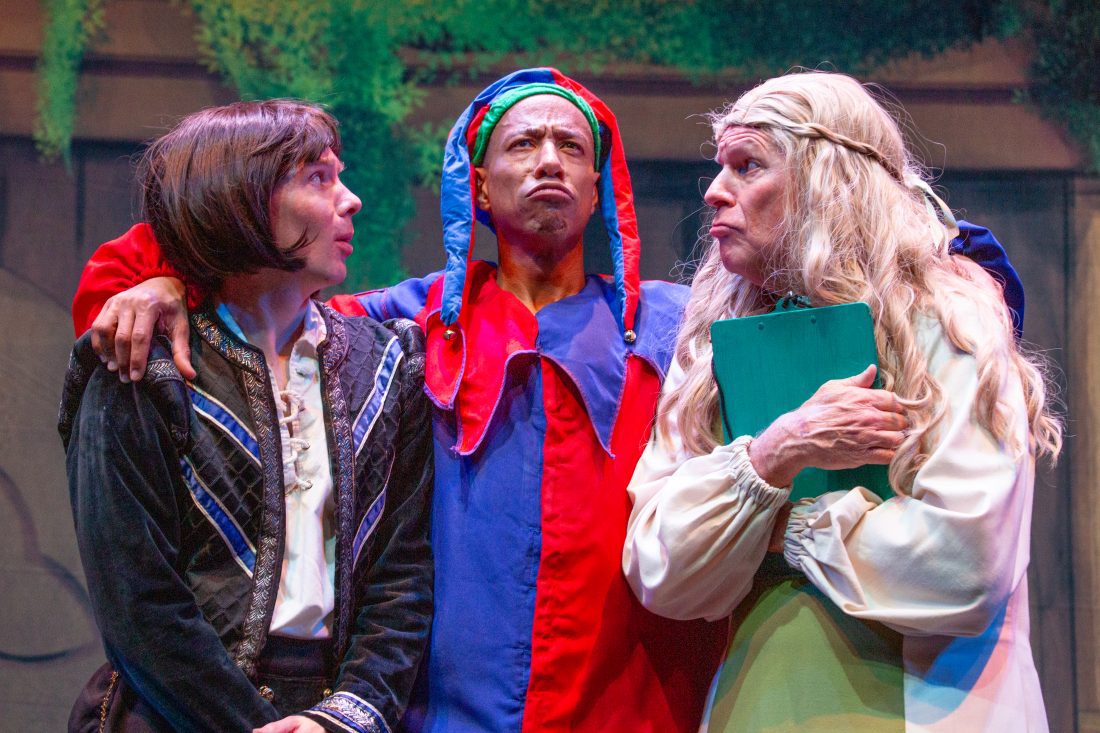
(Photo courtesy of Meg Moore) “Hamlet (Doug Harvey), Yorick (Geoffrey Barnes), and Ophelia (Austin Tichenor) in the Reduced Shakespeare Company production of “The Comedy of Hamlet! (a prequel)” at Merrimack Repertory Theatre, March 2025”
Jesse Nguyen
Connector Editor
For any Journalism and Professional Writing (JPW) student enrolled in Fall 2025 and beyond, their English degree will no longer require them to take either classes ENGL.4230 Shakespeare 1 or ENGL.4240 Shakespeare 2 for completion. Creative Writing (CW) and Theatre Studies still have this requirement, while Literature got rid of it in 2021.
This is a recent change enacted by the UMass Lowell English department and is a change that garned mixed reactions.
Jillian Correa, a senior CW English major, upon hearing this news says “that’s actually so sad.” Even though Shakespeare may not seem relevant for JPW majors, Correa says “I think it’s super relevant, I think it’s more so relevant by the fact that we are undergrads, we are not Ph.D. students. I just think that it’s more so relevant by the fact that we are undergrads. We’re not master’s students… we are going over foundational education on English, literature, writing, storytelling, et cetera, like the ability to read and understand information from works and have real media literacy.”
Correa makes valid points. According to the National Literacy Institute, 54% of adults have a literacy below a sixth grade level, and 20% are below fifth grade level. “The techniques that are being used [in Shakespeare] are foundational to English storytelling…he basically set the foundation for a lot of later works.”
Aaron Preziosi, a senior JPW student, says “I can see why they removed the requirement for JPWs because learning Shakespeare isn’t really all that relevant to learning how to write a good journalistic article with integrity and how to do interviews and how to write professionally in a business kind of way.”
Shakespeare 1 and 2 classes are described as “a study of selected histories, comedies, and tragedies.” When asked why Shakespeare may have implemented in the first place, Preziosi says “I feel like it’s because we’re facing a lot of change when it comes to English as a discipline. I mean like, for the past two years, generative AI has kind of been getting better and better, and at UML, I feel like we’ve really held on to what English traditionally was.”
Indeed, ChatGPT, one of the most popular AI language learning models used to assist in writing and creation, reached 100 million users in just two months after its 2022 launch, according to the Washington Post.
Although Shakespeare was undoubtedly foundational and influential, for literature majors, there are many other authors to choose from to study. Preziosi says “He’s one perspective in an ocean of different kinds of stories and perspectives and histories and cultures… I think I’ve been seeing a lot more of like a multicultural or culturally informed work as an English student rather than it just being Shakespearean, like… this Eurocentric view.”
This rings true. In English classes that aren’t Shakespeare, professors can choose which authors to cover and these often come from diverse backgrounds in order to relate to the course material. For instance, the course ENGL.3450 British Women Novelists examines writers like Charlotte Brontë and Virginia Woolf, and the course ENGL.3280 Writing About Women examines many feminist authors and creators varying in race, ethnicity, age, gender and sexuality. “I feel like removing Shakespeare is emblematic of shifting away from that kind of perspective,” says Preziosi.

