






(Photo courtesy of State House) “Luke Van Horn, UMass Lowell MassPIRG Vice Chair”
Luke Van Horn and Mass PIRG Students
Connector Contributor
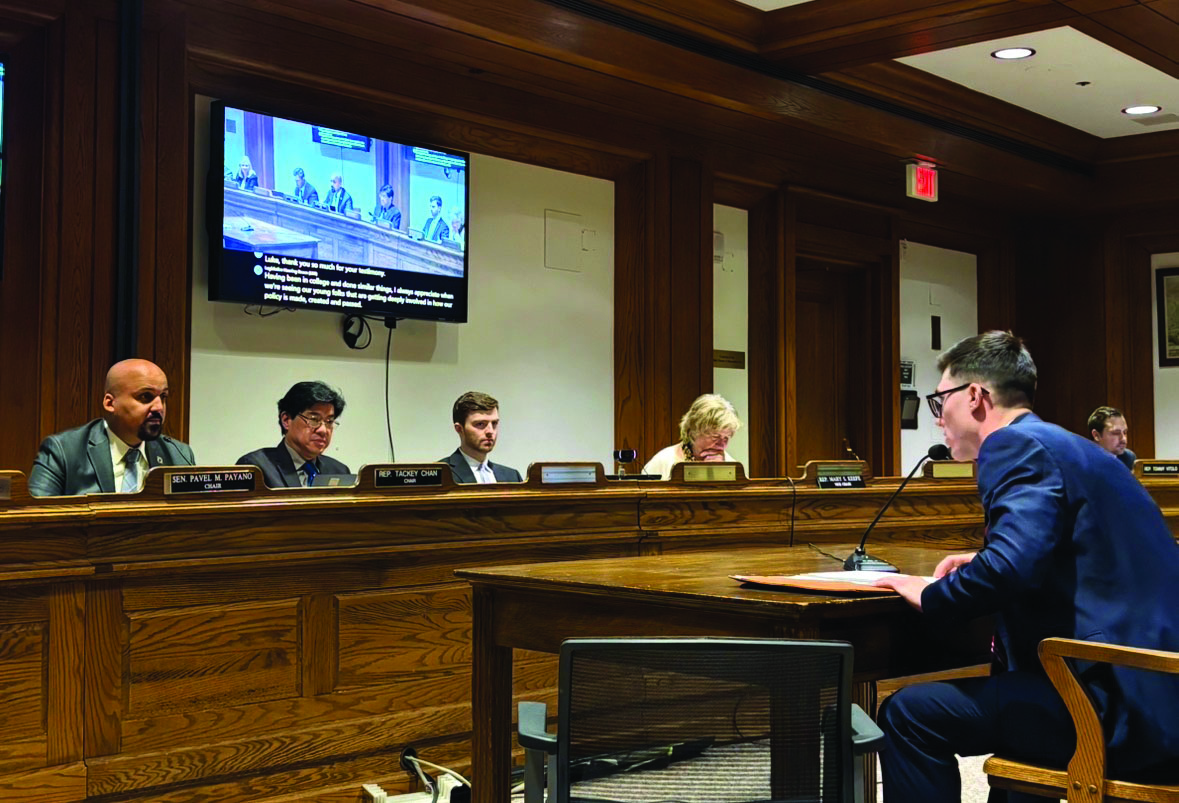
“For all the students out there who have gone hungry because they purchased a textbook. For all the students who have failed classes because of expensive materials. For the hope that this broken market will be fixed one day,” said Luke Van Horn, a junior at UMass Lowell and vice chair of the university’s Massachusetts Public Interest Research Group (MassPIRG) chapter.
On Feb. 4, Van Horn testified in support of “H.559: Resolve providing for an investigation and study by a special commission relative to the consumer impacts of electronic textbooks” before the members of the Joint Committee on Consumer Protection and Professional Licensure. The legislation sponsored by Rep. Domb has the goal of establishing a specialized commission to formally investigate the adverse effects access codes and electronic textbooks impose on students. One of the ongoing issues this legislation aims to resolve is the fact that access codes have become mandatory for students to do homework and take tests, even when other cheaper versions can be found elsewhere.
MassPIRG has regularly conducted studies on the pricing of textbooks since 2004, with their most recent study being conducted this year. The report is the fourth edition of the “Fixing the Broken Textbook Market” report; it serves as an update to the 2021 edition. For this latest report, researchers surveyed more than 4,000 students at 110 colleges and universities nationwide, including over 600 in the commonwealth.
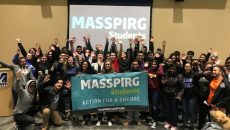
Today, UMass Lowell students, alongside Julie Nash, Senior Vice Provost of Academic Affairs at UMass Lowell, and Donna Mellen, Executive Director of Academic Technology at UMass Lowell, presented the newest edition of the report during a press conference in O’Leary Library. Students held a banner signed by UMass Lowell students calling to “Make Textbooks Affordable” as speakers shared their findings and personal stories.
The study revealed that three-quarters of students surveyed said they needed to buy an access code to do homework or quizzes. The report also studied student experiences with so-called “inclusive access” billing programs, which some campuses in Massachusetts are considering. The data is definitive that campuses should be cautious when considering auto-billing.
Surprisingly, nearly half of the surveyed students at schools with campuswide auto-billing reported not knowing that they were being billed, not knowing that they could opt out or being unable to opt out.
“When students can’t afford course materials, it shows up immediately — missed assignments, delayed participation and avoidable stress. Auto-billing and access codes may be marketed as ‘convenient,’ but they can also reduce choice and transparency and leave students paying for temporary access,” said Nash.
Auto-billing promises savings but these claims are dubious at best. The Public Interest Research Group’s 2024 analysis of 171 of these program contracts found no evidence that they save students money. In fact, in 90% of the bookstore operating contracts for which they could see the details about commission payments, the school received a commission payment based on sales of automatic textbook billing products.
Nash added that, “UMass Lowell has made real progress on textbook affordability by building infrastructure such as faculty mini-grants, hands-on support through our teaching and learning center and strong library partnership to help instructors adopt OER and other non- or low-cost materials.” UMass Lowell does not participate in auto-billing.
Since 1970, the price of textbooks nationally has outpaced inflation by three times, an annual increase of 6%. As textbook costs increase so too does the burden, especially for students who may not be able to keep up with the rising costs while meeting their essential needs.
“Massachusetts has taken bold steps toward free college. I am grateful for that, but tuition alone is not the full cost of education. If we do not address course materials and essential needs, access is only theoretical,” said Kayla Kittredge, a recent Middlesex Community College graduate and first year student at UMass Lowell. “I am standing here today because I had people and institutions that refused to let price decide my future. But many students do not get that chance.”