








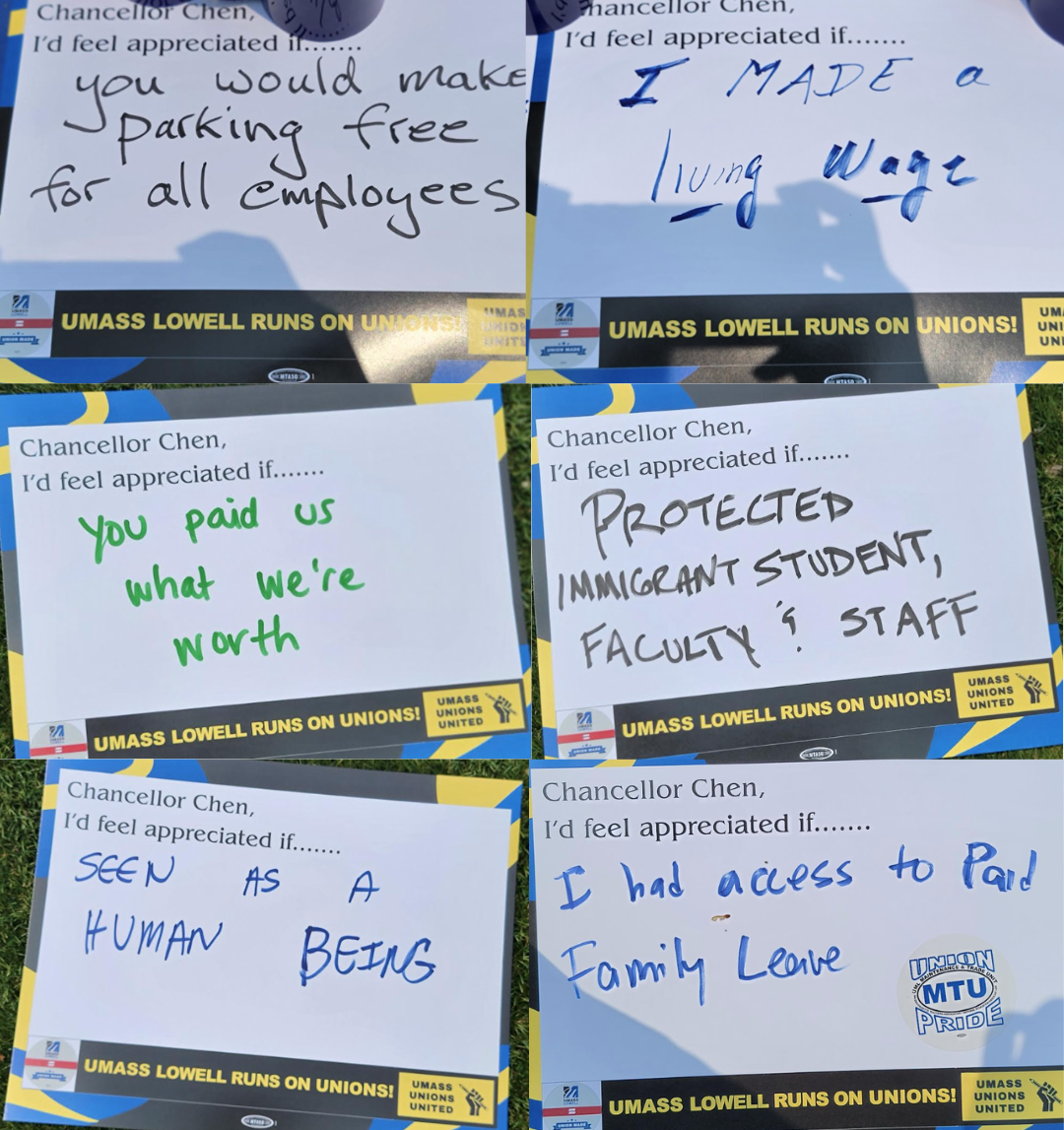
(Photo courtesy of Judith Aquino) Signs made by union members as part of the UMass Lowell Unions United action on Faculty and Staff Appreciation Day in 2025
Najifa Tanjeem, Ava Peters, Adri Jackson
Connector Contributors
Last semester, a UMass Lowell graduate teaching assistant (TA) had to choose between filling a prescription and paying rent. She chose rent. This is not a story about bad luck; but a story about a university that relies on graduate workers to teach students, run labs, and advance research, all while paying them too little to live on.
That graduate worker is not alone. Graduate teaching and research assistants are among the lowest-paid employees on campus. The Graduate Employee Organization (GEO) is currently bargaining for a contract that will determine whether we, graduate workers, can afford to survive. Burdened with unlivable wages, unaffordable housing, and inadequate protections against discrimination and harassment, we spend our days under financial and psychological stress. International students face additional uncertainty in the current political climate. Depression, anxiety, stress, and burnout are not personal failures. They are predictable outcomes of a system that extracts labor while offering little in return. Decisions made in the bargaining room will shape the kind of university this is, who it is actually for, and how it sees the workers who underpin its operations. This question is echoed by faculty, adjunct faculty, staff, and maintenance workers across campus. As graduate workers, we stand alongside them in a coalition of campus unions – UMass Lowell Unions United – who share the same fight.
Issues of low wages, understaffing, and overwork have worsened over the last decade, and the unions of this campus are united in acknowledging this. As Thomas Estabrook, President of the Grants and Contract Employees union, notes: “Salaries have not kept up with living expenses. All while the university is understaffed and workers are overworked in facilities, student support, teaching, and research programs. At the same time, upper administrative bloat is happening. This is the corporate model applied to public higher education.” Ellen Martins, the Union of Adjunct Faculty President, points out: “This especially impacts underpaid and poorly benefited adjunct faculty.” Judith Aquino, President of the Classified and Technical Unit, adds: “Furloughs and layoffs cause disruptions to student support services. Faculty and staff sometimes work without contracts while bargaining. Staff are undervalued. The Campus deserves more investment for everyone who thrives here.”
The irony is that while pushing workers to the margins, the university runs on their labor. As Steve Turcotte, the Secretary of the Maintenance and Trades Unit, puts it: “We keep the toilets flushing, the heat and lights on, and the restrooms clean. We are behind the scenes keeping this university running with 20% fewer workers than two decades ago, covering nearly 40% more square footage.”
Undergraduate students, this matters for you too. When your teaching assistant is choosing between rent and a prescription, they cannot show up fully for you. When staff positions are cut, the advising appointment you need doesn’t happen. When faculty are stretched thin by stalled contracts, the mentorship and research opportunities defining the university’s mission shrink. Our working conditions are intertwined with your learning conditions. And the root cause affects you directly: as Elizabeth Pellerito, the Membership Secretary of the Service Employees International Union Local 888, puts it: “As universities become increasingly corporate, the percentage of state funding for public college and university budgets has declined significantly, and students and workers are covering the difference as tuition and housing costs go up and workers make less.”
The path forward is clear. As Kelly Socia, the Massachusetts Society of Professors Lowell President, explains: “We need to get away from the corporate mindset, period. We have tried it. It has not worked, leading to disgruntled faculty and staff and unhappy students. It’s time for the university and the state to invest in the UMass system, and specifically, the UMass Lowell campus. The state has, literally, billions of dollars earmarked for public education. They need to start spending it.”
This spring, GEO is at the bargaining table asking the university to invest in the people who make it run. Our demands are clear: livable stipends, improved health benefits, subsidized housing, protections for international students, and clear processes for addressing discrimination and harassment. Every union on this campus is standing with us, making the same demand – that this campus and its workers deserve more.
May 1st – International Workers’ Day – was born on the streets of Chicago in 1886, where workers risked everything for an eight-hour workday. The Lowell Mill Girls and the Lawrence Bread and Roses strikers understood that fair wages and human dignity are worth organizing for. We are in the same fight, at this university, right now.
If you believe the people who teach, research, and care for this campus deserve to live with dignity, say so. Come to our events. Talk to your TAs, professors, staff, and workers around you about their struggles. When you see us organizing, stand with us.