





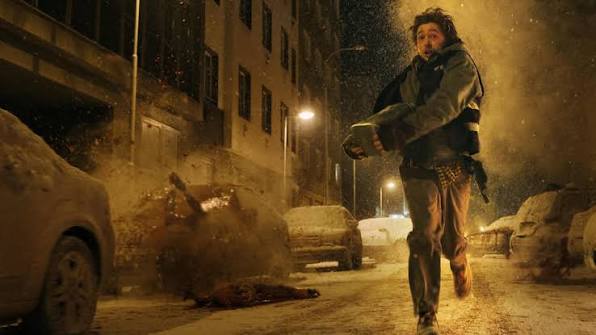
(Image courtesy of IMDb. “’Resident Evil’ ultimately misses the mark on delivering viewers an adequate horror experience.”)
Adelaide Gotti
Connector Contributor
There is a fine line between creatively reinterpreting a beloved film franchise and exploiting its name for commercial purposes. “Resident Evil (2026)” struggles to find that balance, delivering a product that retains little of the original franchise beyond one familiar place name: Raccoon City.
The film’s main weakness lies not only in its departure from the source material, but in its lack of a coherent narrative structure. The plot feels underdeveloped, with no direction or a clear sense of progression. Rather than following a constructed story, viewers are confronted with a succession of grotesque visual set pieces and chaotic situations that rarely achieve their intended effect: generating genuine fear. Dramatic tension is seldom allowed to develop naturally. Instead, the film relies on relentless sensory stimulation and familiar horror tropes, leaving no room for suspense.
Nevertheless, the film’s artistic direction suggests an interesting ambition: to create a claustrophobic, exhausting experience resembling a waking nightmare. The goal appears to be conveying a sense of helplessness in which every decision leads to further trouble and even supposedly competent authorities prove unable to provide any kind of actual assistance.
Unfortunately, the gap between intention and execution is considerable. The oppressive atmosphere the film seeks to establish quickly becomes frustrating rather than suspenseful. The characters’ repeated failures to act logically do little to encourage empathy or heighten tension, instead leaving viewers increasingly detached from their predicament. Similarly, the apparent incompetence of the institutions and experts involved never develops into a meaningful exploration of failure. Incompetence of the institutions often feel like a narrative device designed simply to keep the plot moving. What could have been an unsettling descent into fear consequently becomes a collection of familiar horror clichés that fail to form a cohesive whole.
For fans of the original franchise, the film’s approach to adaptation is another source of disappointment. Remove the name Raccoon City, and the story could arguably bear an entirely different title without significantly changing its identity. The survival-horror tension that made the original films memorable is largely absent, as is the distinctive characterization that has helped establish the franchise as a major part of popular culture over the past three decades. Rather than offering a fresh perspective on a recognizable universe, the film feels disconnected from the elements that made that universe compelling in the first place.
The conclusion reflects many of the problems that precede it. Without revealing major plot details, the resolution feels underdeveloped and narratively unsatisfying. The story moves toward an ending that offers little catharsis, leaving viewers with a sense of incompleteness. Instead of bringing its narrative threads to a meaningful conclusion, the screenplay relies on predictable shortcuts. The result is an ending that feels less like the culmination of a carefully constructed story and more like an attempt to bring it to a close without fully resolving its central ideas.
Ultimately, this new “Resident Evil” represents a missed opportunity. It struggles both as an adaptation of a beloved fictional universe and as a standalone horror film. Its attempt to construct a cinematic nightmare results in an experience that feels more exhausting than frightening. The premise had the potential to explore helplessness, institutional failure, and psychological terror, but these ideas never receive the narrative development they require.
The film serves as a reminder that an intriguing concept alone cannot sustain a horror story. The atmosphere must be supported by effective storytelling, characters whose decisions feel believable and a clear artistic vision. For viewers seeking the tension and survival-horror experience associated with the original games, this installment may be difficult to recommend.
Grade: C+