

UMass Lowell Connector Logo

Thousands gather across country for No Kings protests

(Photo courtesy of Library of Congress) “The United States Capitol”

Makayla Mahoney

Connector Editor

Downtown Lowell’s Kerouac Park was filled with thousands of protesters on Saturday, March 28, according to The Lowell Sun, for the third No Kings protest taking place internationally. This local demonstration was one of more than 3,300 within the U.S., with approximately 8 million protesters in attendance. Several more demonstrations took place globally in countries including Mexico, Ecuador, Puerto Rico, Canada, the U.K., and more.

No Kings is a movement led by partnering organizations, such as 50501, Indivisible, and MoveOn. Their concerns, as written on their website, are as stated:

“Masked secret police terrorizing our communities. An illegal, catastrophic war putting us in danger and driving up our costs. Attacks on our freedom of speech, our civil rights, our freedom to vote. Costs pushing families to the brink. Trump wants to rule over us as a tyrant. But this is America, and power belongs to the people – not to wannabe kings or their billionaire cronies”.

March 28 marked the third and largest No Kings protest throughout the nation, with previous No Kings protests taking place June 14 and October 18 of 2025 largely in response to increasing I.C.E. raids across the country. This No Kings protest further marked the second largest single-day protest in U.S. history, according to Brittanica.

Members and representatives of the Lowell community spoke to the crowd at Kerouac Park for No Kings, including Congresswoman Lori Trahan, State Senator Vanna Howard, State Representative Tara Hong, and members of UMass Lowell’s very own chapter of the College Democrats.

One member who spoke was Deyanarah Gutierrez, the secretary of UMass Lowell Democrats and a senior political science student. This was her first No Kings protest, sharing, “I had missed the first protest and was amazed by the global turnout organized by Indivisible, so when this opportunity came up, I knew I wanted to be there”.

Deyanarah had written a speech to read aloud for the audience, stating: “I wanted my piece to center on love rather than hate, emphasizing the importance of community. My goal was to push back against the way people are often categorized or marginalized by media, stigma, or affiliation. My message was that this country is a place for all of us, and when that sense of belonging is threatened, it creates fear because love is what makes a home.”

An excerpt from her speech titled “A House with Many Homes” is as follows:

“Kings do not sing, they do not see beauty of the art, but for the playthings he may sting with a swing of his wand and flings those who do not follow along. Kings who bring fear do not linger on heart strings they may pull. So it may be time to lace up shoestrings and bowstrings to fight

back as young things who hear the rings of whistles. You need to know this is more than left or right wings. If your heart nerves don’t ping to the sound of S.O.S rings of your neighbors – are you even listening? Kings never wait… they take, they declare, they control; but this is democracy- power is ours, and we will not hand them our soul.”

When asked what No Kings means to her, Deyanarah explained, “‘No Kings’ represents the opportunity to speak up not just out of frustration, but out of hope. It’s about supporting communities that feel threatened or targeted and reminding them that they are not alone.”

The city of Lowell was one of several locations with No King demonstrations across Massachusetts, with one of the largest in the country being in Boston. An estimated 180,000 people attended No Kings in the Boston Commons, with a performance by The Dropkick Murphys and speeches by Governor Maura Healey, Attorney General Andrea Campbell, Senator Ed Markey, and Congresswoman Ayanna Pressley as well as local organizers and advocates.

No Kings organizers are not done yet. Their mission is to “grow from a mobilization into a movement” through further training and local events and meetings. The upcoming event organized by No Kings affiliates is “May Day” which will take place on May 1st, or Labor Day. They are calling for a nationwide economic strike to advocate for workers over billionaires, encouraging “No School. No Work. No Shopping”.

Vanna Howard sworn in as State Senator

(Photo courtesy of Benjamin Heffner) “Dome of the Massachusetts State Capitol”

Olivia O’Sullivan

Connector Staff

On March 18th, Vanna Howard of Lowell made history as the first Cambodian-American state senator in the United States. Coincidentally, March 18th was also the 30th annual Immigrant’s Day at the Massachusetts State House. This was announced at the ceremony, to much applause. According to the Lowell Sun, Howard stated, “I am truly honored that the voters of the first Middlesex District have placed their trust in me. When I first came to this country as a refugee, I could have never imagined being elected to first the House of Representatives and now the Massachusetts State Senate.”

Howard, a survivor of the Khmer Rouge genocide, immigrated to the United States at the age of eleven. She experienced the brutal regime of Pol Pot and suffered immense loss of her family and loved ones. After fleeing Cambodia with her mother in 1979, Howard dedicated her life to helping others, especially in her community.

A UMass Lowell alumnus herself, Vanna Howard has deep roots in the city of Lowell. Howard worked for Congresswoman Nikki Tsongas for over a decade, first as a constituent services representative and then as a regional director for the Greater Lowell area. Howard also served as chair for the Massachusetts Asian American Commission.

In 2018, Nikki Tsongas encouraged her to run for office as a state representative. She won the election for the 17th Middlesex District and made history – as she would continue to do – as the first Cambodian-American state representative in the United States. She has secured millions in funding for housing, childcare, and public infrastructure for the district. Howard also successfully sponsored a bill for establishing April 17th as Cambodian Genocide Remembrance Day.

Her achievements as a state representative as well as her campaign brought her to her swearing-in ceremony on March 18th. During her address to the audience, Howard took a moment to appreciate the community that showed up to support her campaign. She stated, “Although I am the one standing here, this moment belongs to all of us. I want to thank the volunteers and supporters throughout the five communities and beyond that worked hard through a winter campaign… in sometimes minus 5 degree weather to get the message out about our campaign. We did the work because it was important.”

As a state senator, Howard represents the first Middlesex district. This encompasses the constituents of Lowell, Groton, Dunstable, Tyngsborough, Westford, and Pepperell. Howard has built a platform on affordability and community resilience. She advocates for tax cuts for working families as well as making housing and education more accessible.

State Senator Vanna Howard succeeded the seat of the late Edward J. Kennedy, whose work she hopes to continue. To maintain the seat beyond his term, Howard will need to run for reelection during the midterms. Her former competitor in the general election, Sam Meas, implied to the Lowell Sun that he plans to run for the seat again.

In reference to Vanna Howard, political science junior Ronan Dowd said, “It’s fantastic that we have somebody who cares about the district so much in such an important seat.”

Boston Fleet to host PWHL playoff games at Tsongas Center

(Jason Cooke photo) “The Tsongas Center will host PWHL playoff games this spring.”

Jason Cooke
Connector Editor

The national hockey spotlight will once again shine bright on Lowell.

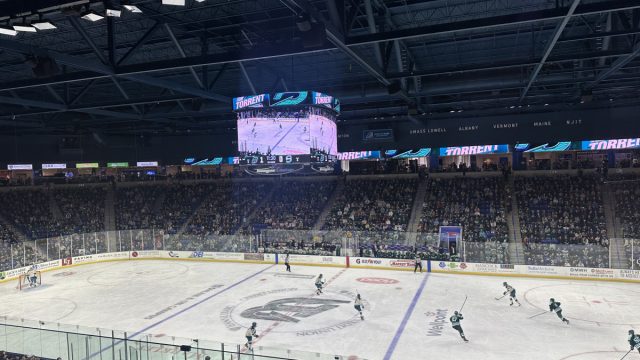
Playoff hockey is set to return to the Tsongas Center this spring in the Professional Women’s Hockey League.

The league-leading Boston Fleet became the first team in the eight-team league to clinch the postseason and the fastest franchise to ever punch its playoff ticket as six games remain in the regular season.

Boston’s resurgence comes after the Fleet missed the postseason a year ago, coming up just one point short in a devastating loss on home ice that would signify a turning point for the organization as the final game for head coach Courtney Kessel and team captain Hilary Knight.

A season prior, the fifth and final game of the Walter Cup Finals put Lowell on a national pedestal when it battled the Minnesota Frost in front of a capacity crowd at the Tsongas in what was perhaps one of the biggest events to be hosted at the venue in recent memory.

Tickets for the first round are currently on sale. And if the Fleet keep up its momentum as of late as a stingy defense-first team with the best goalie in the league, the Walter Cup Finals could very well return to Lowell by May.

Boston clinched its spot in the postseason with a 4-2 win over the two-time defending champion Frost last week and will hit the road against the Vancouver Goldeneyes on Tuesday before returning home on April 11 for a sold-out game at TD Garden in Boston against the Montreal Victoire.

“Coach Sparre spoke at the start of the year in our training camp that we had something to prove,” said Fleet assistant coach Stefanie McKeough. “I think that’s the mentality that we come into every building with and address every game with. From top down in our lineup tonight, we showed that we wanted to do that here in Minnesota and it was a pretty complete game for us. We want to keep rolling; we know that the job’s not done.”

Boston has allowed only two games amid its four-game winning streak after posting a historic three-straight shutouts with Aerin Frankel in net. Amanda Thiele debuted between the pipes in the win over Minnesota.

Frankel hasn’t allowed a goal in an eye-popping 191:01 of play. Her seven shutouts this season are more than any other goalie in the league has not only posted in 2025-26 but in their career. Impressive, to say the least.

In front of her, star defenders Megan Keller and Haley Winn have been two-way dynamos. Both lead the team in time on ice and play a responsible game.

Lowell Spinners to feature UML baseball stars

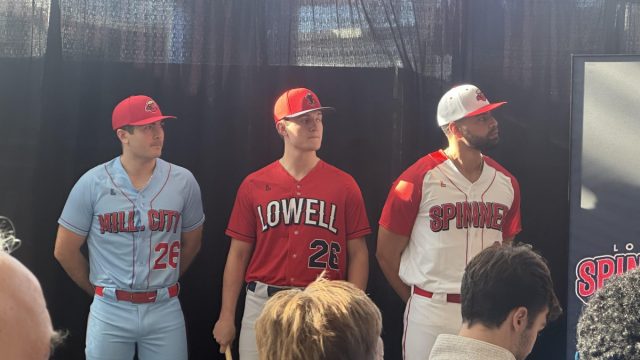
(Jason Cooke photo) “The Lowell Spinners debuted their new uniforms in a November announcement at the Tsongas Center.“

Jason Cooke
Connector Editor

The Lowell Spinners are coming back to LeLacheur Park.

And with that comes a bevy of familiar faces who will wipe the dust off the beloved uniforms for the first time since 2019.

After UMass Lowell officials and Futures Collegiate Baseball League top brass announced that a new franchise would break ground in Lowell last summer — and a new ownership group was unveiled in November — it is almost time for first pitch in the Mill City.

The season kicks off on May 27 before returning to Lowell on May 29 for the season opener. The Spinners were a treasured fixture of the New York-Penn League as the short-season Class-A affiliate of the Boston Red Sox until Major League Baseball restructured the minor leagues in the aftermath of the COVID pandemic.

Summers along the shores of the Merrimack River have been without baseball since.

Red Sox draft picks and prospects may not be taking the field with the reinvigorated Spinners — Mookie Betts notably played for Lowell amid his rise throughout the minor leagues — but the Spinners’ roster is loaded with college talent, including some familiar faces at UMass Lowell.

River Hawks Cal Chance, Chris Klueber, Seamus Scott and Jake Zawatasky will suit up for the Spinners when UML’s college season comes to a close next month.

The FCBL is a premier summer baseball league for college players that fosters an environment focused on player advancement while ensuring all players keep their amateur status. Cam Schlittler, a Walpole native who pitched at Northeastern before debuting with the New York Yankees last season, once played in the Futures League.

All four UML players have impressed on the college diamond so far for the 11-16 River Hawks.

Chance, a freshman catcher, is hitting .274 at the plate and has notched 31 hits and 15 RBIs. Klueber, another freshman, has thrown 16.0 innings and is freshly removed from a clean 1.2 innings of work against Dartmouth, where he struck out three batters and didn’t relinquish a hit.

Scott has made one appearance so far on March 24 against Merrimack, allowing no runs in 3.1 innings. The Lowell native starred at Lowell Catholic last spring. Zawatsky, a sophomore, hasn’t allowed a hit in his last two outings.

LeLacheur Park has also undergone some upgrades to prepare for a slate of 30 home games, highlighted by a top-end video board in left field. Structural improvements were also made on the concourse to accommodate what is expected to be large crowds making their way to Lowell throughout the hot summer months.

Just how different are North and South Campus?

Serena Morris
Connector Contributor

One feature of UMass Lowell that sets it apart from most other universities is its multiple academic campuses. The two campuses allow students to be exposed to a variety of environments and experiences, but students say the division may make it harder to form a cohesive campus community. 

North Campus, home to the engineering, science and business departments, is known for its compact, industrial design, with tunnels connecting nearly every building. South, home to the humanities, is far more open and nature-centered. The two campuses are about a mile and a half apart, meaning most students have to commute by bus to travel between them. 

 While the school’s two campuses have been connected for over 50 years, some feel that the students are still divided to this day. “Honestly, all the campuses feel like a totally separate community. I mean, yeah it’s the same school, but it doesn’t feel like it,” sophomore environmental science major Gabriella Powell says. 

Ella Glass, a sophomore engineering physics major, argues that this feeling of division is due not to the physical distance, but the people. “Students make a big deal about it. The idea that the campuses are very different is sort of like, baked into the culture,” Glass says. 

It’s not only the students who reflect this tension, either. “Even the professors know about it. My engineering ethics professor says that South Campus people joke that North Campus people are just walking calculators,” Glass says. 

Others say this divide is often blown out of proportion. Sarah Rine, director of the Office of Student Life and Involvement, feels the community is more unified than people sometimes think. “Not everyone only goes to North or only goes to South. I think it’s more about highlighting the benefits of both campuses and helping students to be exposed to each campus and the benefits and the differences it brings,” she says.   

While it’s apparent that many see the campuses as having different vibes, there’s debate on what each campuses’ vibe truly is. “South Campus has a lot of interesting people,” Powell says. “You’ll see clubs on the lawn meet late at night, or just people chilling on the lawn chairs. So, the atmosphere and vibe is a lot better because you’ll see people out more than North.” 

Others’ conceptions as to which campus is more social are flipped.  “Personally, I do not leave South Campus,” says political science major Adriana Adrien. “But I’ve heard from other people that Fox and the residence halls near there, they’re more inclusive and they’re more of a community, rather than when we’re at South, people are more by themselves.” 

While it’s clear there are differences in atmosphere, some feel that may not be a bad thing. “I think it’s okay to have differences and have different energy or different experiences across campus,” Rine says. “I think if it was just one same thing all the time, that maybe students would actually get a little bored.” 

While this divide between STEM and humanities majors exists at nearly all colleges, others feel the physical separation between UML’s campuses may exacerbate it. “The transportation options between the campuses aren’t great, people who only have classes on one campus tend to mostly like, seclude themselves to the campus they have classes on, and barely interact with one another,” says industrial engineering major Maddie Smith. 

Powell, who lives on South Campus, agrees that the transportation plays a major factor: “It comes down to how far they are to each other. I feel like I’m commuting to go to classes. Waiting for the bus and taking like, 30 minutes to go to class, I feel like one of them, even though I dorm,” she said. 

With transportation so difficult at times, students can struggle to feel any interest in exploring the other campuses. “I don’t think I would ever go to North if I didn’t have classes,” Powell says. “People aren’t really at North besides classes. Like, I would never meet up with friends there unless we’re waiting in between classes.” 

Students may be able to feel more connected to the entire community if they take time to explore the area. “I encourage people to remember that campus isn’t just North and South, but that there’s University crossing and East Campus, and then the Tsongas Center and also to go and explore downtown or explore the neighborhoods adjacent to campus,” Rine says.   

Rine said she believes exploring campus is vital to developing the school’s sense of connection. “I would never want a student to think it’s only where their academic classes happen, but we have so much more to offer them, and their participation in it will help us build the community,” she said. 

How are students’ eating habits affected by attending college?

Charles Che Guevara
Connector Contributor

Students say they have changed their routines because of classes. Lunches aren’t scheduled anymore, and the consistent workflow of high school has changed to a day-to-day work schedule meaning free time to eat fluctuates too, they say. Administrators say they want to help students by pointing to campus resources that can help. 

Students skip meals, spend money on groceries and eat out constantly because classes and work take up too much time. Students say they are more independent but may not have easy access to a trusted adult or expert to help with any questions about food. Administration is helping students address the issues of skipping meals and being cost effective.  

Students say that they often forget to eat. Junior Alans Delis Cordova Debora, a computer science major who lives on campus, says that his day-to-day schedule affects what he eats. “Sometimes classes can be a little heavy, so I don’t have too much time to go eat,” he said. 

Professor Mary Kate Keyes, a clinical instructor at UMass Lowell, says that she is aware that many students go through their days without preparing time to eat. “They go to class, to work, to class, kind of all over, and they don’t plan or don’t have time to go for a meal in the dining hall, or they hadn’t made time earlier in the day to pack a healthful lunch or dinner or something like that,” Keyes said. 

Time and stress are not the only factors that go into a change in eating habits. Cordova said that sometimes he skips out on eating because the weather makes it difficult to venture out.  

Cordova also said his job as a resident advisor means he must be deliberate about when he eats or he might not eat at all. Cordova said that he plans his meals before shifts, classes or even interviews. “I try to eat before my shift. So, before the interview I ate,” he said.  

Others say commuting often affects their eating habits. “I work before I go to classes in the evening, so I find that I will prepare my whole day of eating the night before,” said Jane Njeri Mumo, a psychology major. 

Students have found new dieting habits to fit their changed environment. Mumo said she prepares her meals at the beginning of the week. “Sometimes I’ll meal prep and freeze cooked food, and sometimes I’ll just make fresh meals,” she said. 

Cordova said how he likes to cook on occasion but usually prefers sticking to quick meals such as instant ramen. Cordova says he likes preparing frozen foods and then cooking something to add to the mix (ramen and eggs, for example).  

Keyes said that eating poorly is better than eating nothing at all. “Ideally, you would add some fruits and vegetables on the side. But I would rather have a student have some frozen pizza and go to bed with food in their tummy than have nothing.”  

For the students who often forget to eat, having friends as a reminder to eat is also a great resource. “Sometimes I eat because my friends…they give me a reason to go eat,” Cordova said. Keyes said that having peers recommend dieting habits is also useful. She also listed some on campus resources for students who may need food.  

The Strive is a program that provides food items and case management support to address challenges students are having in meeting their basic needs. On-campus students can also donate up to two meal swipes to those in need through the SOS program. Keyes said eating well is important but that, “we don’t have to let perfection get in the way of progress.” 

Resources for commuter students at UMass Lowell

Annalee Barbar
Connector Contributor

Transportation Services, Student and Family Support Services and The Solution Center described resources available to commuter students, including parking and shuttle services, off-campus housing support and assistance with financial aid, billing, class registration and transcripts. 

With 63% of undergraduate students commuting, according to 2019 University data, these resources play an essential role in supporting students’ daily needs. From navigating transportation to securing housing and handling administrative tasks, commuter students often depend on multiple offices to stay on track academically and financially.   

Transportation Services at UMass Lowell manages the shuttle bus lines that connect all of the school’s campuses. The department also works with the Lowell Regional Transit Authority (LRTA) to help students travel to and from campus. Nathan Klosowski, Assistant Director of Transportation and Fleet Management at UMass Lowell, explained that many students may not realize the usefulness of the regional bus system. The LRTA network connects Lowell with several surrounding communities, though buses typically run every 30 minutes at most, and many routes run hourly. Because of this, he said students may need to plan their trips in advance. “I think a lot of students probably don’t know how useful the LRTA could be,” Klosowski said. The LRTA is free for everyone, but has always been free for UMass Lowell students.   

While regional transit provides one option for reaching campus, parking services also play an important role in supporting commuter students. UCard, Access and Parking Services (UCAPS) also supports commuter students by managing parking permits and campus access. Evan Fallon, Associate Director of Business and Service Operations for UCAPS at UMass Lowell, said one option many students overlook is the campus carpool program, which allows commuters who share a vehicle to split the cost of a parking permit and access designated spaces closer to campus buildings. “We do have a carpool program on campus that I don’t think a lot of kids take advantage of,” Fallon said. This program allows two commuter students to share a vehicle, split the cost of a permit, and park in more convenient locations. On the UMass Lowell official website under The Office of Sustainability, students can find the carpooling guidelines and application.   

Students also have access to metered parking lots across campus with a two-hour limit. These spaces are intended for short visits, such as stopping by the bookstore or running a quick errand. Students can pay for metered parking through the ParkMobile app, which allows them to manage parking from their phones. Because the lots are small, the time limit helps ensure parking remains available for students and visitors who only need brief access to campus.  

Beyond transportation and parking resources, the university also offers support for students searching for off-campus housing. Marshall Greenleaf, Director of Student and Family Support Services at UMass Lowell, explained that availability, cost and location are common hurdles. “Finding an apartment or some off-campus housing, sometimes can be a little bit challenging. Depending on when people are looking and things like the size and location of the apartment,” he said.  

UMass Lowell partners with On Campus Partners, a company that manages apartment listings for colleges and universities. The platform allows students to search for housing based on amenities, proximity to transportation and nearby services such as grocery stores or childcare. It also includes a roommate-matching feature limited to verified UMass Lowell students and provides resources on topics such as reading leases and understanding tenant rights, helping students make more informed housing decisions.  

Greenleaf’s advice to students is to conduct thorough research, visit the apartment or property in person, and if this is not possible, look at photos and read reviews if they are available. He also stressed the importance of understanding the lease and having a second set of eyes reviewing it, because it is difficult to go back once it is signed.  

The Solution Center at UMass Lowell provides a “one-stop” hub for student administrative needs, including financial aid, billing, class registration and transcripts. Angela Glaude, Associate Director, explained that the center serves all types of students, including undergraduate, graduate, on-campus and online students through in-person visits, phone and email. 

The center assists with FAFSA questions, financial aid awards, scholarship inquiries, course registration issues and student billing, including payment plans and reimbursement requests. Glaude said the most common question students ask is about financial aid awards and how much of their bill will be covered. She encouraged students to use the center’s frequently asked questions page, noting that it is often underutilized. “Just knowing that we’re here, that’s the big thing, is realizing that we’re here, what we do for students, and coming in, calling or emailing,” Glaude said. 

Commuter students at UMass Lowell navigate a complex mix of transportation, housing and administrative challenges. The university’s resources help make daily life more manageable. Students are encouraged to explore these services and visit the offices’ websites, as there may be tools and support they haven’t yet discovered.

The embarrassment of Chris Kempczinski and the decline of fast food

(Photo courtesy of msn.org) “After McDonald’s CEO Chris Kempczinski went viral for his Big Arch taste test, other fast-food executives decided to join in on the fun.

Aaron Preziosi
Connector Editor

By now everyone has seen the video of McDonald’s CEO Chris Kempczinski trying the new Big Arch sandwich, if one could even call the miniscule morsel he extracted from what might pass as a burger a “bite.” This spawned many reaction videos and clapbacks from other CEOs from companies such as Burger King and Costco, flaming Kempczinski for his hesitance to partake of the food his company creates, as if he silently admitted that it’s barely food at all and shouldn’t be eaten. However, the imagery of the CEO of one of the oldest, most well-known fast food chains in the world refusing to enjoy the food his company creates and referring to a sandwich as a “product” bummed me out and got me thinking about how fast food has changed in the past few years. 

What the hell is going on? Sure, fast food was never regarded for its high quality or nutritional value, but it was fast, as well as cheap and consistent. When I worked for McDonald’s in high school, the two-cheeseburger, drink and fry combo was nine dollars. Maybe ten, if you got a large. When I went just the other day, it was thirteen dollars! I could go to Pressed in Chelmsford or something and get an amazing gourmet sandwich for a similar price, so what’s the point of spending that on crappy beef patties, cheap buns and fake cheese with a side of old and stale or soggy fries, especially when you have to pull over and wait half the time? 

The same thing has been happening in other places, too. “High end” places such as Chipotle have been suffering similarly as well. You end up spending fourteen to fifteen bucks per person, and they barely give you any meat. Once again, I could go to Mexica in Billerica or Tewksbury for the same price and end up getting a larger bowl or burrito with similar but higher quality ingredients. Plus, they have churros. 

I think the decline in fast-food marks a shift in our culture, to be honest. We shouldn’t be eating out of the hands of these enormous corporations who see what they make as “products” rather than food, and wouldn’t be caught dead eating those products themselves, especially since they can no longer beat other restaurants when it comes to price. There’s so many small, independent restaurants or even good chains in our communities and its high time they get the business they deserve. They’re led by average people with a real passion for feeding people, not businesspeople who would rather maximize profits and cut costs. 

Here’s some of my favorite places. Give them your money instead of someone who won’t even eat his own sandwich: 

Mexica Burrito Grill (Billerica and Tewksbury): Build-your-own burrito place. It’s like chipotle, but fresher and smaller. They offer burritos, bowls, tacos and nachos, and they have drinks and desserts too. The churros are amazing. They even have alcohol at the Tewksbury location. 

Pressed (Chelmsford): Sandwich, coffee and juice café. This place is great. The atmosphere is nice, there’s plenty of seats and the food comes out fast. The drinks are pricey, but they are also delicious, and they have take-home pastries, drinks and side dishes too. They also have a drive-thru. 

Augusta’s (Billerica): Sub shop known for their chicken bites. You’ve probably heard of this place, and for good reasons. While their prices have gone up recently due to their expanding business, they have the portions to back it up. They load their sandwiches up high and if you order the chicken bites they absolutely pack the box full. 

Taqueria Sabor Chilango (Billerica): This is a smaller, family-owned taqueria with a great menu. They’ve got all kinds of authentic Mexico City street foods, and even offerings like lengua and chorizo. Absolutely worth visiting. 

Cobblestones (Lowell): Right down the street from North Campus, this place has great American offerings like steaks, burgers and seafood. My personal favorite dish has to be their take on Chicken Marsala. The sauce is rich and velvety, but not too thick or overseasoned, and the chicken is always tender and lightly breaded. The pasta comes out perfectly al dente as well. 

So please, with all of this in mind, go try some good food in your local neighborhood and stop giving fast food restaurants your money.