









UMass Lowell Connector Logo

Overworked, Underpaid, and Undervalued – Why This International Workers’ Day Matters at UMass Lowell

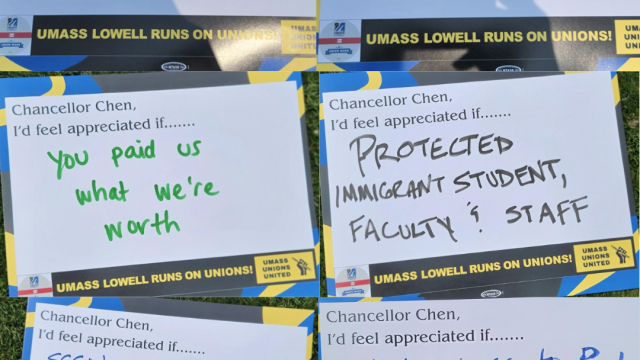
(Photo courtesy of Judith Aquino)  Signs made by union members as part of the UMass Lowell Unions United action on Faculty and Staff Appreciation Day in 2025

Najifa Tanjeem, Ava Peters, Adri Jackson
Connector Contributors

Last semester, a UMass Lowell graduate teaching assistant (TA) had to choose between filling a prescription and paying rent. She chose rent. This is not a story about bad luck; but a story about a university that relies on graduate workers to teach students, run labs, and advance research, all while paying them too little to live on. 

That graduate worker is not alone. Graduate teaching and research assistants are among the lowest-paid employees on campus. The Graduate Employee Organization (GEO) is currently bargaining for a contract that will determine whether we, graduate workers, can afford to survive. Burdened with unlivable wages, unaffordable housing, and inadequate protections against discrimination and harassment, we spend our days under financial and psychological stress. International students face additional uncertainty in the current political climate. Depression, anxiety, stress, and burnout are not personal failures. They are predictable outcomes of a system that extracts labor while offering little in return. Decisions made in the bargaining room will shape the kind of university this is, who it is actually for, and how it sees the workers who underpin its operations. This question is echoed by faculty, adjunct faculty, staff, and maintenance workers across campus. As graduate workers, we stand alongside them in a coalition of campus unions – UMass Lowell Unions United – who share the same fight. 

Issues of low wages, understaffing, and overwork have worsened over the last decade, and the unions of this campus are united in acknowledging this. As Thomas Estabrook, President of the Grants and Contract Employees union, notes: “Salaries have not kept up with living expenses. All while the university is understaffed and workers are overworked in facilities, student support, teaching, and research programs. At the same time, upper administrative bloat is happening. This is the corporate model applied to public higher education.” Ellen Martins, the Union of Adjunct Faculty President, points out: “This especially impacts underpaid and poorly benefited adjunct faculty.” Judith Aquino, President of the Classified and Technical Unit, adds: “Furloughs and layoffs cause disruptions to student support services. Faculty and staff sometimes work without contracts while bargaining. Staff are undervalued. The Campus deserves more investment for everyone who thrives here.” 

The irony is that while pushing workers to the margins, the university runs on their labor. As Steve Turcotte, the Secretary of the Maintenance and Trades Unit, puts it: “We keep the toilets flushing, the heat and lights on, and the restrooms clean. We are behind the scenes keeping this university running with 20% fewer workers than two decades ago, covering nearly 40% more square footage.” 

Undergraduate students, this matters for you too. When your teaching assistant is choosing between rent and a prescription, they cannot show up fully for you. When staff positions are cut, the advising appointment you need doesn’t happen. When faculty are stretched thin by stalled contracts, the mentorship and research opportunities defining the university’s mission shrink. Our working conditions are intertwined with your learning conditions. And the root cause affects you directly: as Elizabeth Pellerito, the Membership Secretary of the Service Employees International Union Local 888, puts it: “As universities become increasingly corporate, the percentage of state funding for public college and university budgets has declined significantly, and students and workers are covering the difference as tuition and housing costs go up and workers make less.” 

The path forward is clear. As Kelly Socia, the Massachusetts Society of Professors Lowell President, explains: “We need to get away from the corporate mindset, period. We have tried it. It has not worked, leading to disgruntled faculty and staff and unhappy students. It’s time for the university and the state to invest in the UMass system, and specifically, the UMass Lowell campus. The state has, literally, billions of dollars earmarked for public education. They need to start spending it.” 

This spring, GEO is at the bargaining table asking the university to invest in the people who make it run. Our demands are clear: livable stipends, improved health benefits, subsidized housing, protections for international students, and clear processes for addressing discrimination and harassment. Every union on this campus is standing with us, making the same demand – that this campus and its workers deserve more. 

May 1st – International Workers’ Day – was born on the streets of Chicago in 1886, where workers risked everything for an eight-hour workday. The Lowell Mill Girls and the Lawrence Bread and Roses strikers understood that fair wages and human dignity are worth organizing for. We are in the same fight, at this university, right now. 

If you believe the people who teach, research, and care for this campus deserve to live with dignity, say so. Come to our events. Talk to your TAs, professors, staff, and workers around you about their struggles. When you see us organizing, stand with us.


 

Importance of voting for college students

Benjamin Donovan

Connector Contributor

According to the Center for Information & Research on Civic Learning & Engagement (CIRCLE), young people’s participation in elections dropped in 2024. Young people ages 18-29, only 47% of them participated in the 2024 Presidential election, 3% lower than the 50% that did in the 2020 election. This begs the question of why young adults choose not to vote in elections. Local elections often have low voter turnouts, often due to being less publicized than national elections.

The lack of publicization of local elections causes many young voters to be less informed, causing them to not vote in local elections as they do not know enough about a candidate to truly vote for them. Local elections are just as if not more important than national elections. Local governments have the power to regulate and decide what one’s city can do regarding issues such as housing, schools, and local law enforcement. Local governments handle essential services for everyday lives of those living within their jurisdiction. Electing officials in local governments is crucial, and even a way for young adults to get used to voting in elections.

The 26th Amendment of the United States Constitution lowered the permitted minimum voting age from 21 to 18, nationwide. This Amendment was ratified on July 1, 1971, in the midst of widespread of anti-war protests, fighting against American troops fighting in Vietnam, many arguing that if 18 is old enough to fight in a war, then that is old enough to vote. The Amendment ensures that no state can deny the right to vote for any citizen 18 years of age or older.

When asked about the importance of voting in elections, Dr. John Cluverius, an associate Political Science professor at UMass Lowell, with an expertise in American Politics and Political Methodology, said “I think that voting is something that is a civic duty that people have. The power to influence your government is something that people have fought for in both wars and violent conflicts and profoundly organized political action that has reverberated across the world.” Voting is arguably the biggest way citizens can have influence on their government, which is the very foundation of the U.S. government is supposed to be based on.

Cluverius also discussed the topic of why young adults choose not to vote, pointing at the minimum age to be in the House of Representatives is 25, but there is no age maximum and there are not a lot of 25-year-olds in Congress. He argues that with a lot of members of Congress or government offices in general, have a lot of older people that are not reaching out to young voters and giving them a reason to vote for them. Cluverius believes that if candidates and officials can get younger people to be more involved there would be a stronger turnout. He stated “If people want young people to vote, give young people something to vote for.”

Celia Canavan, the Executive Director of the League of Women’s Voters of Massachusetts (LWVMA), also made statements on why young adults choose not to vote. Canavan, who is Gen Z herself, discusses that there is a fatigue among young voters for a long time as each election is referred to “the election of a lifetime.” The idea that every election is going to be the biggest election the country has ever seen, makes young adults more tired and annoyed at having to participate in elections. Canavan says “I think where young people are getting disconnected is that there’s this perceived reality that November is going to completely change your life immediately. And then there’s the actual reality of we have a lot of damage control to do and there’s a lot of coming together and the political division in this country being as deep as it is.”

Young adults often may not choose to vote also because they are not told enough about the importance of it. A way that this can be solved is by more encouragement from parents, teachers, or any adult figures for young adults to educate them on the importance of elections. That the duty to vote and the importance of it should be discussed more in classrooms, to get kids to understand it and once they get to be of voting age they will be more willing to vote.

Massachusetts State Representative Sean Garballey for the 23rd Middlesex District, representing Arlington and West Medford, has stated that educating kids on civic duties is a way to get them to develop the habit of voting. “I think in our classrooms we’re not as serious as we should be about civics, and creating the positive habits that get developed to create lifelong voters, who are interested in voting, in participating. I think young people are kind of told that their opinion doesn’t matter as much as older people, that they’re young and they’re inexperienced, and maybe naïve” says Garballey.

Garballey has been working on a piece of legislation for a decade that would lower the voting age for local elections to 16 years old. Garballey believes that if you create this habit of voting, starting with local elections, when an individual is 16 or 17 years old, that when they reach 18 and can vote nationally, the habit of voting will already be there. When Garballey was 20 years old he won a seat on the Arlington School Committee, and when he was 22 he got elected to the Massachusetts House. Garballey describes the experience “when I would knock on doors people would say ‘oh you’re too young. I have shoes older than you,’ you know whatever to demean a young person from running for office or being involved.”

Despite minimum ages to be a member of a State House of Representatives varying on each state ranging from ages 18-25, there is still this perceived notion that some people are “too young” to be involved in politics. While votes from older adults are just as important, the discouragement for young voters, convincing them that their vote does not matter or that they are too young to understand the world is a major factor in what gets them to not vote. Candidates and politicians that are running for offices, local or national, should start to encourage young adults to participate in voting, to give them a reason to vote for them. Especially since even if it does not seem like it to those that do not have any involvement in politics, the government’s decisions and laws affect everyone.

This year, general elections will be on November 3, including a U.S. Senate seat for Massachusetts as well as many local elections around the Commonwealth. This year has many great opportunities to start voting.

Nvidia’s DLSS 5 pushes graphics in a new direction

(Image courtesy of Nvidia. “DLSS 5 will use AI-powered rendering to change the graphics of games in real time.”)

Jesse Nguyen
Connector Editor

Video games, much like other media forms, have consistently improved as time passes and new breakthroughs occur. Games are increasingly released with more talented voice actors, more complex stories, and more sophisticated gameplay. An aspect of videos games that have grown rapidly is graphics. Graphics not only defines how a game looks but can also give a game a unique identity. A recent breakthrough in graphical technology is DLSS 5 released by NVIDA, a technology that utilizesgenerative AI to change a games visual fidelity (how closely something mimics the physics and appearance of a real-world subject).

A video demo posted on YouTube showcasing DLSS 5 posted on Mar. 16, 2026, utilized a handful of triple AAA titles like “Resident Evil Requiem,” “Starfield” and more to showcase the technology. All the games shown in this video already have realistic art styles, with nothing bordering close to the likes of “Mario” or other highly stylized games.

An article published by Henry Lin on NVIDA’s website describes how this technology works, saying “DLSS 5 takes a game’s color and motion vectors for each frame as input, and uses an AI model to infuse the scene with photoreal lighting and materials that are anchored to source 3D content and consistent from frame to frame. DLSS 5 runs in real time at up to 4K resolution for smooth, interactive gameplay.”

DLSS 5 is not entirely random in how it works, with Lin saying, “artists can determine where and how enhancements are applied to maintain each game’s unique aesthetic.”

The main focus of this DLSS 5 technology is “bridging the cinematic gap,” giving developers the tools to make video games look more akin to photorealistic Hollywood films.

In the video, the first clip utilizes Grace from “Resident Evil Requiem” as the subject for applying the DLSS 5 setting. With DLSS 5 on, she may look more realistic, but she doesn’t necessarily look like herself. The setting gives her more defined cheekbones, slightly higher set eyes, and deeper smile lines. What’s most visually apparent is how bright everything becomes, which may be due to how most AI models are trained on images and videos with lighting coming from any number of directions.

The “Hogwarts Legacy” clip additionally showcases the technologies difficulty in comprehending shadows and composition, with the hard shadows on the right side of the characters face completely disappearing.

The gaming industry has made great strides in improving visual graphics in the past 30 years. In the 1990s, it was a miracle to see games move from the 2D plane to 3D, with Doom (1993) being one of the most popular pioneers of such a feat. In the early to late2000s, game studios started to showcase the rapidly advancing technology they had developed with “Crysis” (2007) exhibiting a world filled with complex lighting, lush environments and high-resolution textures. This also signaled a time when games, particularly triple AAA games, shifted towards a more cinematic, Hollywood-like aesthetic, with “Uncharted 2” (2009) as a pioneer of this.

Most triple AAA titles released in the past ten years lean more towards a realistic art style, with more stylized games almost always being indie releases, or in Nintendo’scase, IPs that have already existed for several years.

With so much money on the line, it’s feasible to imagine that triple AAA studios lean towards this realistic style to better appeal to a wide audience. There can also be a deep-seated consumer consumption that better graphics means a better product.

Artistically, there can be many reasons why a game would want to lean towards a more realistic style. Perhaps it’s easier to emphasize with characters that appear the same as the player, or immersion was an important part in the games design.

With the advent of real-time ray tracing in 2018, a technology that simulates realistic lighting visuals and reflections, games like “Cyberpunk 2077” (2020) helped showcasethe full extent of how realistic these games can look.

Unfortunately, this realism often comes at a cost. “Cyberpunk 2077” was initiallyreleased as a graphical, performance nightmare, with the most powerful graphics cards at the time struggling to run the game. After several patches and updates, this is no longer an issue, but this pattern can be seen with other modern hyper-realistic games, like “Monster Hunter Wilds” released on Feb. 28 2025.

“Wilds” released with extreme performance issues, with many players expecting frequent crashes and overall poor visuals. Several updates have improved its performance issues, but the game still sits at a 69% approval rating on Steam.

The biggest question regarding video game graphics is the cost. A lot of reviews on “Wilds” doesn’t necessarily complain only about graphics, but other aspects about the game such as the shift away from the classic gameplay loop of what made the series “Monster Hunter” itself.

Are video games incessant focus on visual fidelity hindering other parts of it, like gameplay, mechanics and what really sets video games apart from other media forms? After all, 8 out of the 10 highest rated video games on Metacritic from 2025 do not have realistic art styles. That’s not to say realism makes video games bad, but it may be time to consider what the most important part of video games is and where technology should be developing.

Gosling and Ortiz star in “Project Hail Mary”

(Image courtesy of IMDB. “Ryan Gosling and James Ortiz star in a spacefaring adventure in ‘Project Hail Mary’.”)

Emily Lindtveit
Connector Staff

The much-anticipated movie adaptation Andy Weir’s bestselling novel “Project Hail Mary” was released March 20, 2026. The movie follows a science teacher and less than willing astronaut Ryland Grace (Ryan Gosling) and his attempt to save his planet from a sun-eating parasite. Grace, who wakes up from a coma with no memory of his life before trying to figure out anything, is left alone after his crewmates die due to system failures. His life comes back in flashes as he works through life on the ship. While on the ship, Grace meets another life form Rocky (James Ortiz) who is also trying to save his planet from the same sun eating parasite.

Ryan Gosling delivers a very charismatic performance, one that surprised for sure. He played Grace very convincingly. The relationships he forms with the Project Hail Mary team are realistic, but it also gives the ending a lot of reasoning. His character was charming, albeit in an awkward sense, but did not come off as Ryan Gosling playing himself. He played Grace’s awkwardness and intelligence well. Grace’s character goes through an interesting arc, where although he is smart while on earth and is their choice for going up, he’s treated by everyone else as a little dumb. He’s extremely competent, and that is shown more effectively when he is alone on the ship in space. His more selfless decisions towards the end feel in line with his character and how he has changed since leaving Earth.

The relationship that blooms between Grace and Rocky is obviously the character relationship at the forefront of the film. They form a tenuous partnership at first, just looking for the solution to their respective parasite problems. Overtime, they become closer friends and sacrifice different things for each other. Although that relationship is great, and the best in the film, the small friendships Grace forms with some of the humans on earth are also sweet. Eva (Sandra Hüller) and Carl (Lionel Boyce) become the first to believe in Grace’s idea, and to fully believe in his involvement in Project Hail Mary.

One of the films’ best attributes was definitely visual storytelling, and cinematography in general. Because a large part of the first hour when Grace and Rocky meet, they do not have a common language; a lot of their communication is done through visuals. The simplistic back and forth of them trying to communicate illustrate very well the struggles they are having. Even some of the transitions between Grace’s present moments on the ship and his past as a teacher or working for the government are edited very well, and show how jarring some of these memory flashes are for Grace. The cinematography is absolutely gorgeous, with shots of outside the ship and planets being standouts. The humor was well balanced, especially while on earth everything is so serious. There were very few laugh-out-loud moments, but that wasn’t necessary for successful comedic reliefs in the film. It was more subtle humor, and made the audience laugh without it feeling cheap. Rocky easily provides some of the funnier moments, certainly due to his naivety about how humanity operates.

The pacing overall is a little slow, but there is a necessity to it because of how complex the problem is. Some of the science may go over the audience’s head, and yes, it is a long watch, but it’s a movie worth checking out. It delivers a great story, with compelling arcs for characters and beautiful visuals of Grace and Rocky saving the stars. Grade: A-

2026 Spring SGA Election Results

Benjamin Heffner

Connector Editor

Listed below are the certified 2026 SGA spring election results:

            President & Vice President (top 1 elected):

                        Bryce Lee/Muriel Merheb: 42 (100.0%) ✓

            Student Trustee (top 1 elected):

                        Tucker Norton: 43 (100.0%) ✓

            Senators At-Large (top 9 elected):

                        Nancy Tekityamazzi: 43 (18.8%) ✓

                        Nathan Contorelli: 24 (10.5%) ✓

                        Merolla Dakkash: 24 (10.5%) ✓

                        Muhammad Naeem: 24 (10.5%) ✓

                        Michael Silman: 24 (10.5%) ✓

                        Mia Czarnecki: 23 (10.0%) ✓

                        Maretchia Dakash: 23 (10.0%) ✓

                        Keyko Diesing: 23 (10.0%) ✓

                        Jolia Sifien: 21 (9.2%) ✓

            Fine Arts, Humanities, and Social Sciences (FAHSS) Senator (top 4 elected):

                        Hope Bunnell: 12 (34.3%) ✓

                        Heidy Rodriguez: 10 (28.6%) ✓

                        Sean Antin: 8 (22.9%) ✓

                        Mera Hanna: 5 (14.3%) ✓

            Francis College of Engineering Senators (top 4 elected):

                        Erney Tefal: 6 (30.0%) ✓

                        Sid McQuaid: 5 (25.0%) ✓

                        Kyle Ray-Dutra: 5 (25.0%) ✓

                        Gabriel Rivers: 4 (20.0%) ✓

            Kennedy College of Sciences Senators (top 4 elected):

                        Maahi Pant: 15 (44.1%) ✓

                        Arjun Gupte: 7 (20.6%) ✓

                        Ewan Grant: 6 (17.6%) ✓

                        Nida Tahreem: 6 (17.6%) ✓

            Manning School of Business Senators (top 2 elected):

                        Bruno Jacob: 9 (52.9%) ✓

                        Anthony Massaro: 8 (47.1%) ✓

            Zuckerburg College of Health Sciences (ZCHS) Senators (top 2 elected):

                        Eden Adams: 1 (100.0%) ✓

                        Silvia Wahba: 0 (0.0%) ✓

            Class of 2027 President (top 1 elected):

                        Cole Stepanik: 5 (100.0%) ✓

            Class of 2027 Vice President (top 1 elected):

                        Aaron King: 5 (100.0%) ✓

            Class of 2027 Secretary (top 1 elected):

                        Paige Matthews: 5 (100.0%) ✓

            Class of 2027 Treasurer (top 1 elected): Paige Matthews

                        Courtney Houde: 5 (100.0%) ✓

43 votes were cast out of roughly 12,000 undergraduate students, a 0.4% turnout.

Lowell’s seventh annual Town and the City festival

(Photo courtesy of The Town and The City Festival) 2026 The Town and The City Festival Schedule

Makayla Mahoney
Connector Staff

The Town and The City Festival is making its way back to Lowell for its seventh annual weekend celebrating local musicians and artists. The festival will take place from Thursday, April 30, to Saturday, May 2, set in several businesses and restaurants across downtown Lowell, including Taffeta Music Hall, Warp & Weft, Lala Books, The Worthen Café and Brew’d Awakening. 

Day passes are $51 and the weekend pass is $81, while tickets for single shows are available for lower prices. Tickets can be purchased on their website or at specific times at the Revolutionary Valley Regional Tourism Office, Merrimack Repertoire Theater or Taffeta Music Hall. 

Each day will be filled with several performances in various locations in the evenings. Headliners for The Town and The City Festival include local bands and artists such as Copilot, Cristina Vane, David Lowery, Future Teens and GA-20. 

All music lovers are encouraged to attend, with all genres of music being performed that weekend. Indie, rock, blues, pop, country, R&B, soul, hip hop and jazz are some of the many genres to be expected, as well as comedy performances and book readings. 

Lowell galleries and exhibitions will be open as well, displaying local artists’ work and celebrating Lowell’s history and creativity. People are welcome to visit Brush Gallery Studios, Arts League of Lowell, Loading Dock Gallery and The Whistler House Museum of Art. 

The Town and The City Festival began back in the fall of 2018 to celebrate the famous Lowell author, Jack Kerouac. Their website states: 

“The Town and The City Festival is inspired by the creativity and exploration for which the author was so famously known and will present a diverse mix of musical genres and artistic disciplines to inspire discovery and to celebrate a love of life.” 

The festival is named after Jack Kerouac’s first novel, published in 1950, which takes place in a Massachusetts town named Galloway, representing the town of Lowell of which Kerouac was born and raised. Jack Kerouac is a prominent figure in Lowell’s history, celebrated for his world-famous novels and pioneering of the beat generation: a non-conformist cultural and art movement of the 1950s. 

Karl Sargent, a freshman nuclear engineering student at UMass Lowell, shared his take on the opportunity to have such events in Lowell: “Having art and culture in the city is important because it connects the people to the city more and makes it a more enjoyable city for all of us.” 

The Town and The City Festival is a great way to enjoy the art, music and creativity that Lowell has to offer as one of Massachusetts’ most historical cities. 

For more information on the event or to get involved, visit their website: https://www.thetownandthecityfestival.com/ 

To get a taste of what the festival has in store, listen to their spotify playlist: https://open.spotify.com/playlist/71nL9c8xniIyuembfn2BlE?si=MxKN2EMTTxqsHcTH06AjNg 


End of semester events for student relaxation

Aaliyah Afolabi
Connector Staff

As the semester and academic school year is coming to an end, with events like graduation and the completion of freshmen’s first year of college and finals, there are various feelings of happiness, melancholy, bittersweetness and stress that are felt by many students. To combat the latter of these emotions, there are events going on throughout the rest of the semester to help ease the effects of these feelings. From April 21 to May 10, the end of the semester, there will be many featured events held by student organizations for the UMass Lowell community to enjoy. A few of the campus organizations holding these events are the Office of Sustainability, the Arts and Design Department (ARTS), the Music Department, Association for Campus Events (ACE), and so on. 

In honor of Earth Day, on April 22, the Office of Sustainability will be hosting an Eco-Fest event on the lawn of the Campus Recreation Center. This will be an exciting outdoor celebration of sustainability, wellness and community. Whether one is passionate about the planet or just looking to enjoy a beautiful day outside, there’s something for everyone! You can expect sustainable education and activities, tabling from local organizations and student groups, free samples from local restaurants, ice cream and sliders, lawn games, fitness classes, a bouncy house and more. Going on from 11 a.m. to 2 p.m., feel free to partake in this celebration dedicated to the protection, awareness and preservation of our precious planet. On April 23, from 5:30 to 8 p.m. in Mahoney Hall’s Comley Lane Theater, will hold a celebration of the beautiful and irreplaceable art of graphic design. This event will celebrate the boundless creativity of the UMass Lowell BFA Graphic Design seniors. The event will begin with a screening and awards, followed by food, drinks and exhibitions in the University Gallery. View this as an oil painting artwork gallery, but digital, and most excitingly, free!  

Get ready for an immersive gaming experience as the Video Game Ensemble returns with electrifying new arrangements from your favorite video game soundtracks! On April 28, from 8 to 9 p.m. in the Moloney Performing Arts Center Concert Hall Seating, you can enjoy a thrilling night where our bands bring these iconic scores to life, seamlessly synced with live and prerecorded gameplay video. Also on the program, UMass Lowell’s Contemporary Electronic Ensemble has been pushing the boundaries of music with groundbreaking, dynamic performances that challenge and excite. The students craft original compositions and innovative arrangements, using electronics as the core of their creative expression. Those who are interested, especially “Mario Kart” fans, feel free to pop up.  Starting from April 18, ACE will be hosting a series of entertaining and engaging events all throughout the week. Starting off, there’s the day trip to the famous New York City. Students will have nearly a whole day of exploring the city before meeting back up before sunset to head back to Lowell. On April 21, a few days after, there will be a high energy bingo night featuring 16 amazing prizes in University Crossing from 6 to 8 p.m. Some of these prizes include a Meta Quest 3S, an iPad Pro, Sony XM5 headphones, a Ninja Creami and a Nintendo Switch. The day after, April 22, is the sunset social. This social will feature photo booths, crafts, giveaways, açaí bowl building and more. Last but not least, is the spring carnival on April 23, on the Riverview fields, from 5 to 8 p.m. This will include music, free rides, free foods and more, all for free.  

After such a busy semester everyone deserves a little break from work. Students are encouraged to take advantage of these upcoming events and take care of their mental health during these last weeks of the semester. For more information on campus events, students and staff can check out the Campus Group Events Calendar and the MyUML featured events page. 

“Tomodachi Life: Living the Dream” demo creates hype among fans

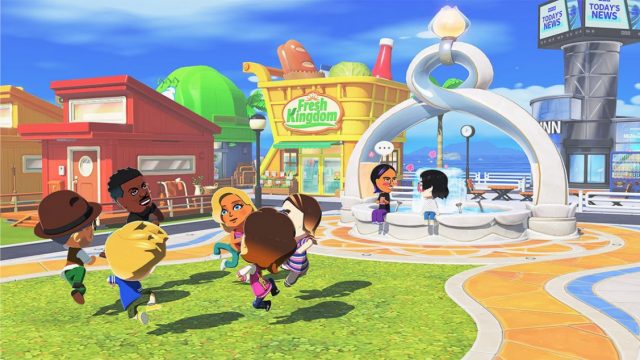
(Image courtesy of Nintendo of America. “‘Tomodachi Life: Living the Dream’ lets players watch an island of characters go through a life of strange happenings.”)

Rosalie Pineda
Connector Contributor

With the highly anticipated sequel to “Tomodachi Life” set to release on April 16 this year, nobody expected a free demo to drop on the Nintendo E-shop. Since the Welcome Version of “Tomodachi Life: Living the Dream” was made available for download on March 25, the internet has been abuzz with hilarious screenshots and growing excitement for the full release.

When starting the demo, the game jumps players right into it. Players are given a small island to look around with the camera, which in itself is a neat upgrade from the first game. Fans of the original game will recall how limited the camera movement was; there was no free movement nor rotation of the camera at all. Now, in this new game, just being able to get a full 360-degree view of a Mii’s room enhances the liveliness of the world.

The demo lets players make their very first Mii within minutes. This is where the fun really starts. Almost every part of the Mii is customizable; there’s a greater diversity of eyes, noses, hairstyles, and colors. Face paint offers an even wider variety of designs for Miis, and although the interface can be overwhelming at a glance, this feature has been especially embraced online. Some players have spent at least an hour designing their perfect Miis, leading to some genuinely impressive recreations of everything from fictional characters to something as abstract as popcorn. There’s even an option to upload real images from the Switch onto the Mii’s face. It’s absurd and wonderful.

Every Mii’s gender and dating preferences can be toggled as well. Notably, a nonbinary option has been added, and Miis can fall in love with the same gender (a highly requested feature from fans of the first game). It’s even possible to customize their clothing preferences for scripted events like weddings. Voices and personality types can also be customized, although for some reason, players are no longer able to choose a Mii’s favorite color.

Another appreciated feature is the option to specify which Miis are related to each other. One unpopular aspect about the first “Tomodachi Life” was the inability to indicate which Miis were related to each other in real life, which would lead to embarrassing situations when these Miis would develop romantic feelings for each other. Thankfully, in the new game, romantic interactions are barred for related Miis.

Players can also make up to three Miis in the demo. Having three Miis on the island provides a pretty good preview of what they can do; not only do they have funny interactions with each other, but they can also be fed, petted, and carried around the island. They can be gifted things like a soccer ball, expressions, and little quirks, which gives every Mii even more personality.

In a recent FAQ, it was confirmed that the number of Miis available to register would be 70. This is a significant decrease from the first game, which allowed 100 Miis to be registered. The reason for the change is unknown, but it is a bit disappointing, especially for players who had planned to make over 70 Miis.

Also, unlike its predecessor, “Tomodachi Life: Living the Dream” has no online sharing features. In the first “Tomodachi Life” game, sharing Mii designs and screenshots online was a popular way for players

to connect with each other. While this is certainly a bummer, one stand-out feature from the demo could explain why this change was made: there is an absolute lack of filter.

It’s common for many Nintendo games to restrict players from typing certain words or phrases that could be offensive, including curse words. This restriction applied to the original “Tomodachi Life” as well. The sequel, however, surprised everyone by completely getting rid of that filter. Dialogue options are more customizable, and this has led to a hilarious amount of screenshots where Miis express themselves in ways they never could have otherwise.

Perhaps the developers thought, “If they’re going to work around the censors anyway, why restrict them at all?” After all, it isn’t quite “living the dream” for some people if they can’t use certain words, which is why this freedom should hopefully extend to the retail version of the game.

It’s exciting to think about what could happen down the line in this digital age. When “Tomodachi Life” came out 13 years ago, the Nintendo 3DS was all the hype. A new generation of kids and adults alike are getting the chance to try out this game, and the creative opportunities presented to them are limitless.

Impressions are clear: this feels like just the beginning for the full game’s financial success.

Grade: A